
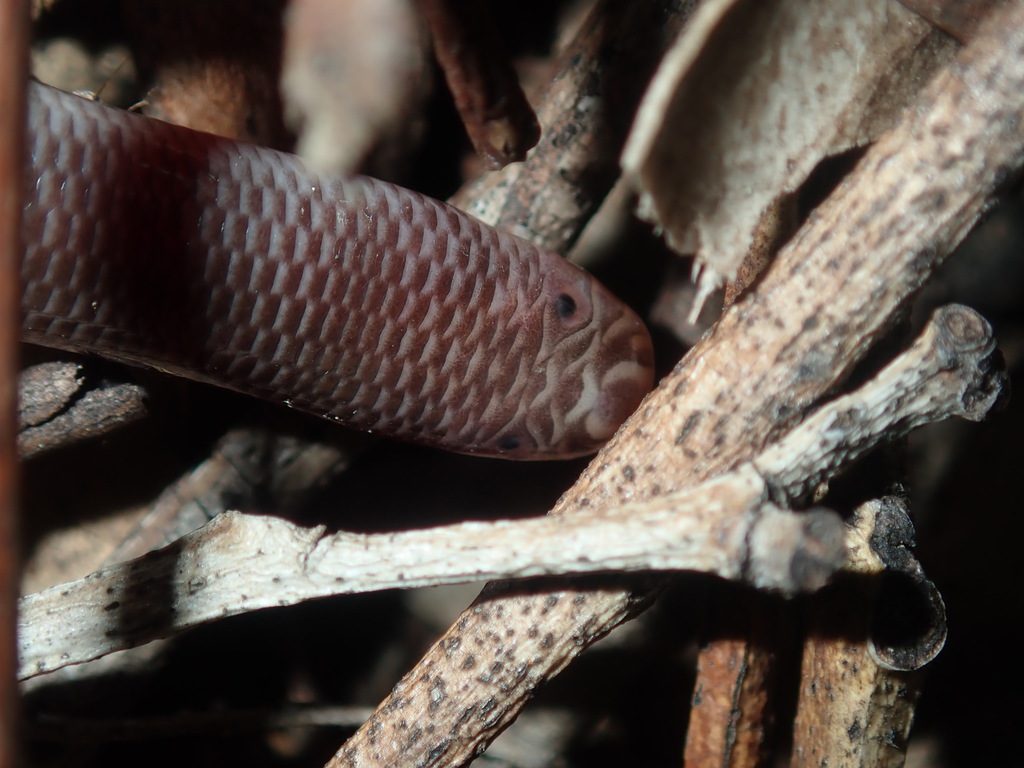
Photo: Thomas Mesaglio · CC BY 4.0 · iNaturalist
Blind Snake
Anilios nigrescens
Mistaken for a worm by almost everyone who finds one — and the Bandy Bandy’s entire diet.
- Length
- 20–50 cm
- Active
- Nocturnal, burrowing
- Habitat
- Underground; mulch, compost, ant and termite nests
- Diet
- Ant and termite larvae, pupae and eggs
- Status
- Protected wildlife — licensed handlers only
Compare before you decide. Never act on an identification made from a photo or a guide, including this one.
Do not wash the bite, do not apply a tourniquet and do not try to catch the snake. Keep the person still, apply a pressure immobilisation bandage if you have one, and get emergency help immediately.
Native reptiles are protected wildlife. Taking, handling, moving or harming one without the appropriate permit is an offence under Queensland's Nature Conservation Act 1992 and carries significant penalties — as well as being the fastest way to get hurt.
Blind snakes are the most commonly overlooked snakes in South East Queensland, largely because most people who find one assume they have found a worm.
They are completely harmless. They have no venom, no functional teeth for biting anything larger than an ant larva, and no capacity or inclination to defend themselves against a person.
They matter to this guide for two reasons. They are constantly mistaken for something else, and they are the entire diet of the Bandy Bandy.
About the Blind Snake
Blind snakes are smooth, shiny and uniformly cylindrical, usually 20 to 50 centimetres long and no thicker than a pencil. The body is the same diameter from end to end, with no neck and no obvious taper.
Colour is typically pinkish-brown, grey-brown or dark purplish-brown, with a paler underside. The scales are tightly overlapping and highly polished, which is one of the surest ways to tell one from an earthworm — a blind snake is dry, scaled and glossy, where a worm is soft and segmented.
The eyes are vestigial: two dark spots beneath the head scales, capable of detecting light but not of forming an image. Both the head and the tail are blunt, and the tail ends in a tiny spine, so it can genuinely be hard to tell which end is which.
Habitat
Where can you find a Blind Snake?
Blind snakes live underground and are found almost everywhere in South East Queensland:
- garden beds and mulch
- under rocks, logs and pavers
- compost heaps
- ant and termite nests
- loose soil and leaf litter
They surface most often after heavy rain, when their burrows flood, which is why so many are found on paths and driveways during and after a downpour. They are also turned up regularly by digging and gardening.
Venom
Is the Blind Snake dangerous?
No. Blind snakes are entirely non-venomous and completely harmless to people and pets. They cannot deliver a meaningful bite.
Their only defence is to writhe and to release a strong-smelling fluid from glands near the tail, which deters some predators and does nothing worse to a human than smell unpleasant.
They remain protected wildlife like every other native snake, so they should not be collected or relocated by unlicensed people — but there is no safety concern here at all.
Diet
What does the Blind Snake eat?
Blind snakes are specialists that feed inside ant and termite colonies:
- ant larvae and pupae
- termite larvae and eggs
- ant eggs
They enter the nest, feed, and leave. Their tightly overlapping polished scales and the fluid they secrete are thought to protect them from the ants while they are inside.
Behaviour
What should you know about this species?
Blind snakes are fossorial, meaning they live underground, and they navigate almost entirely by scent — following ant and termite pheromone trails back to the nest.
Because they are so rarely above ground, they are far more common than sightings suggest. A garden that has never produced a blind snake almost certainly still has them.
They are also an important food source. The Bandy Bandy feeds on blind snakes almost exclusively, so a healthy blind snake population is what supports one of the most striking snakes in the region.
What to do if you see a Blind Snake
Nothing at all is required. It poses no risk to anyone and will burrow back down on its own once conditions suit it.
If it is stranded on concrete in the sun after rain, moving it a short distance to shaded soil or mulch is a kindness, though as with all native wildlife the strictly correct course is to leave it be.
If you are not certain it is a blind snake — and small dark snakes are exactly where people get identification wrong — do not handle it. Photograph it and send it to us instead.
Contributed photographs, reused under Creative Commons licences. Colour and pattern vary a lot between individuals — compare several before settling on an ID.
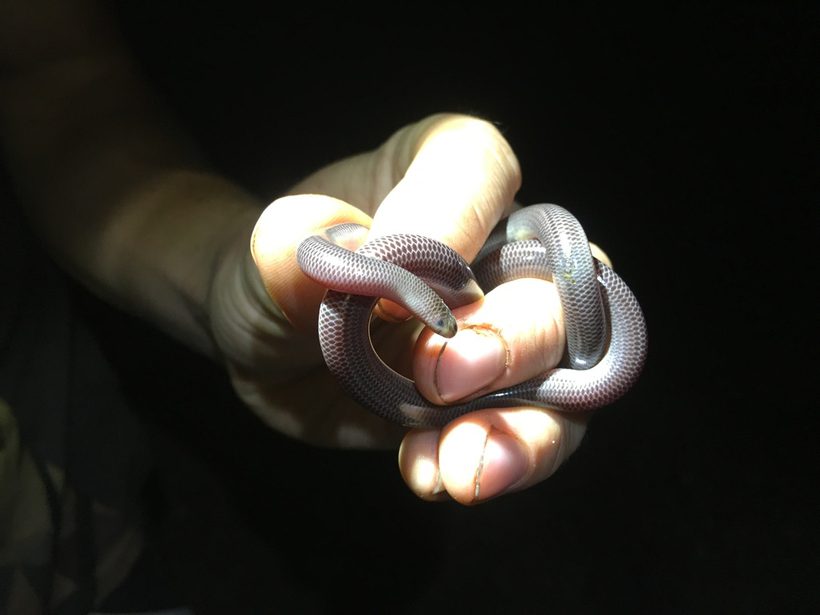
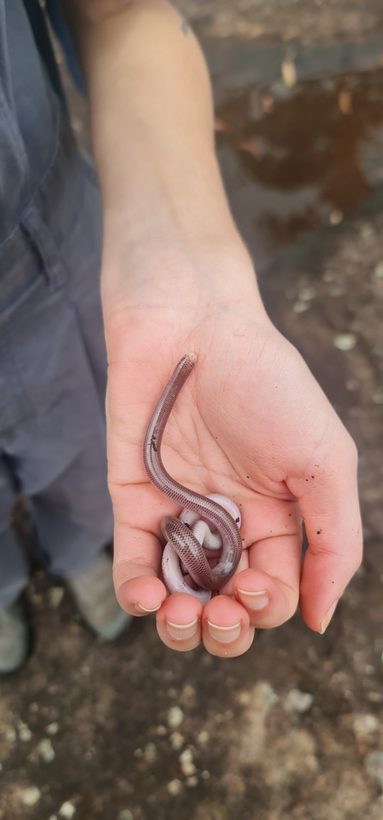
Photo: Donna Belder · CC BY 4.0 · iNaturalist
Photo: no rights reserved · CC0 · iNaturalist
Asked on
most call-outs.
Is this a snake or a worm?
Are blind snakes venomous?
Why do I only see them after rain?
Could it be a baby venomous snake?
What do they eat?
Should I move it out of my garden?
Call or text — a licensed handler will talk you through it. If someone has been bitten, call 000 first.