
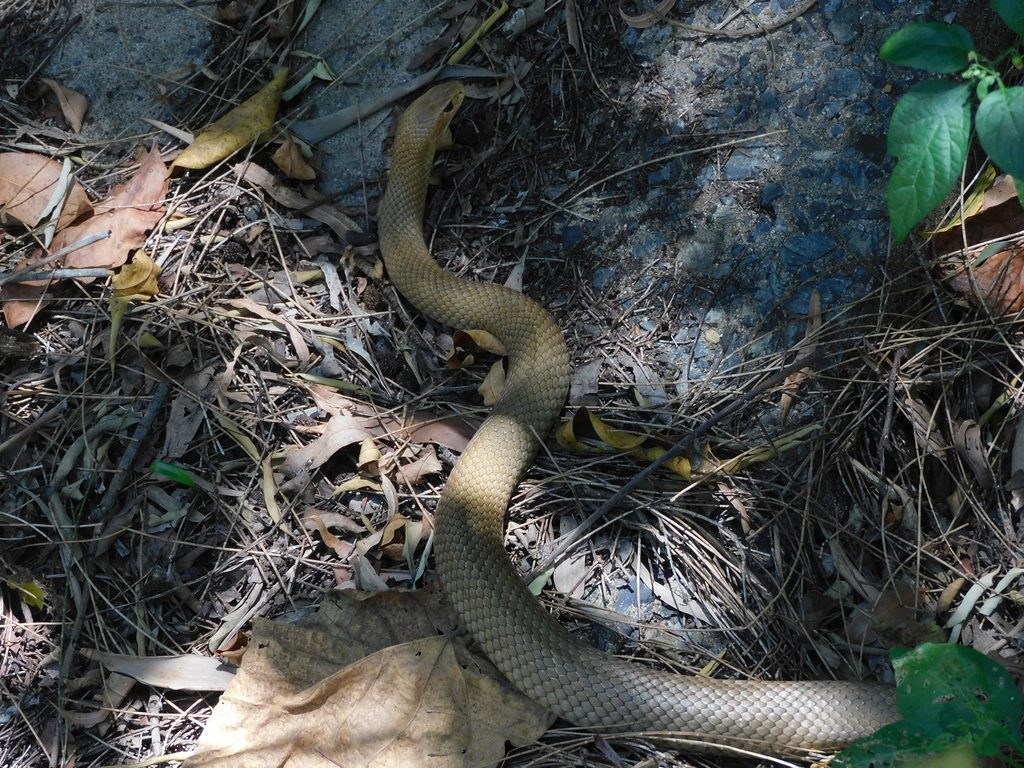
Photo: no rights reserved · CC0 · iNaturalist
Eastern Brown Snake
Pseudonaja textilis
The one to know. Common, fast, highly venomous — and rarely the colour the name suggests.
- Length
- 1.5 m, to over 2 m
- Active
- Diurnal
- Habitat
- Grassland, farmland, sheds, suburban yards
- Diet
- Mice and rats, lizards, frogs, other snakes
- Status
- Protected wildlife — licensed handlers only
Compare before you decide. Never act on an identification made from a photo or a guide, including this one.
Do not wash the bite, do not apply a tourniquet and do not try to catch the snake. Keep the person still, apply a pressure immobilisation bandage if you have one, and get emergency help immediately.
Native reptiles are protected wildlife. Taking, handling, moving or harming one without the appropriate permit is an offence under Queensland's Nature Conservation Act 1992 and carries significant penalties — as well as being the fastest way to get hurt.
The Eastern Brown Snake is the species we most want people on the Sunshine Coast to be able to recognise. It is common across South East Queensland, it is highly venomous, and it is responsible for more snakebite deaths in Australia than any other snake.
Despite the name, colour is one of the least reliable ways to identify this species. Individuals range from pale tan through orange-brown and grey to almost black, and a brown snake is not always brown.
They are fast, alert, and active during the day, particularly on warm mornings. Most encounters happen when a snake is moving through open ground and is disturbed.
About the Eastern Brown Snake
Eastern Browns are a slender to moderately built snake, most often around 1.5 metres in length, with larger individuals exceeding 2 metres.
The body is usually a fairly uniform colour along its length, with no strong pattern in adults. The belly is typically cream, yellow or pale orange, often with darker orange or grey blotches. The head is not strongly distinct from the neck, and the eye is relatively large with a round pupil.
Juveniles look different enough to be mistaken for another species entirely. Young Eastern Browns often have a dark head and a separate dark band across the nape, and some individuals are banded along the whole body. A small banded snake in South East Queensland should never be assumed to be harmless.
Habitat
Where can you find an Eastern Brown Snake?
This species does very well in modified and open country, which is a large part of why encounters are so common. Typical habitats include:
- open grassland and paddocks
- farmland and rural properties
- dry woodland and forest edges
- suburban yards, gardens and acreage
- sheds, garages, rubbish piles and stacked timber
They are strongly associated with rodents, so properties with rats or mice, feed sheds, compost heaps and chook pens are far more likely to see them. Reducing rodents on a property is the single most effective thing you can do to reduce brown snake encounters.
Venom
Is the Eastern Brown Snake dangerous?
Yes. The Eastern Brown Snake is highly venomous and every bite must be treated as a medical emergency. On the standard laboratory measure of venom toxicity it ranks second only to the Inland Taipan.
The venom affects blood clotting and the nervous system. What makes this species particularly dangerous is that the bite itself can be almost painless and may leave little or no visible mark, so a serious envenomation can be underestimated in the first few minutes.
Apply a pressure immobilisation bandage, keep the person as still as possible, and call 000 immediately. Do not wash the bite site, do not apply a tourniquet, and do not attempt to catch or identify the snake by approaching it.
Diet
What does the Eastern Brown Snake eat?
Eastern Browns are active hunters with excellent eyesight, and rodents make up the bulk of an adult's diet. Prey commonly includes:
- mice and rats
- small lizards and skinks
- frogs
- birds and eggs
- other snakes
Juveniles feed mainly on small lizards and shift toward mammals as they grow.
Behaviour
What should you know about this species?
Eastern Browns are diurnal, meaning they hunt during the day, and they are fast movers. A snake crossing open ground at speed on a warm morning in South East Queensland is very often this species.
They are nervous rather than aggressive. A snake that feels cornered may raise the front of its body into an S-shape, flatten its neck, gape its mouth and strike — but this is defensive display, and a snake given an escape route will almost always take it.
The overwhelming majority of Eastern Brown bites happen while someone is trying to catch, kill or move the snake. Leaving it alone is not just the legal option, it is by a wide margin the safest one.
What to do if you see an Eastern Brown Snake
Stop, move back, and take everyone else with you. Keep children and pets well inside, and give the snake a clear path away from where people are.
Do not approach it for a photo. If you can watch it from behind a window or from a long distance and see where it goes, that helps us enormously — but not at the cost of getting close.
Call a licensed snake catcher. Remember that snakes are protected wildlife, and attempting to kill one is both illegal and the most common way people are bitten.
Contributed photographs, reused under Creative Commons licences. Colour and pattern vary a lot between individuals — compare several before settling on an ID.
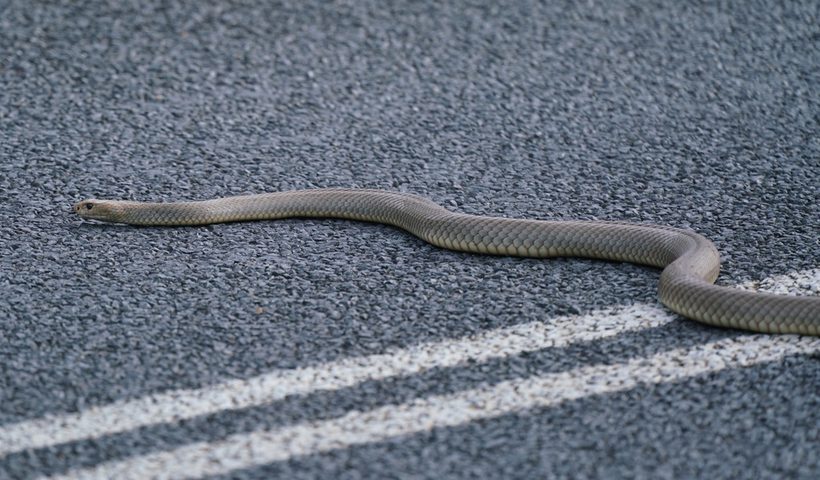
Photo: Tim · CC BY 4.0 · iNaturalist
Asked on
most call-outs.
How do you identify an Eastern Brown Snake?
Are all brown-coloured snakes Eastern Brown Snakes?
How dangerous is an Eastern Brown Snake bite?
Are Eastern Brown Snakes aggressive?
Why do I keep seeing them on my property?
Are baby Eastern Brown Snakes dangerous?
Call or text — a licensed handler will talk you through it. If someone has been bitten, call 000 first.