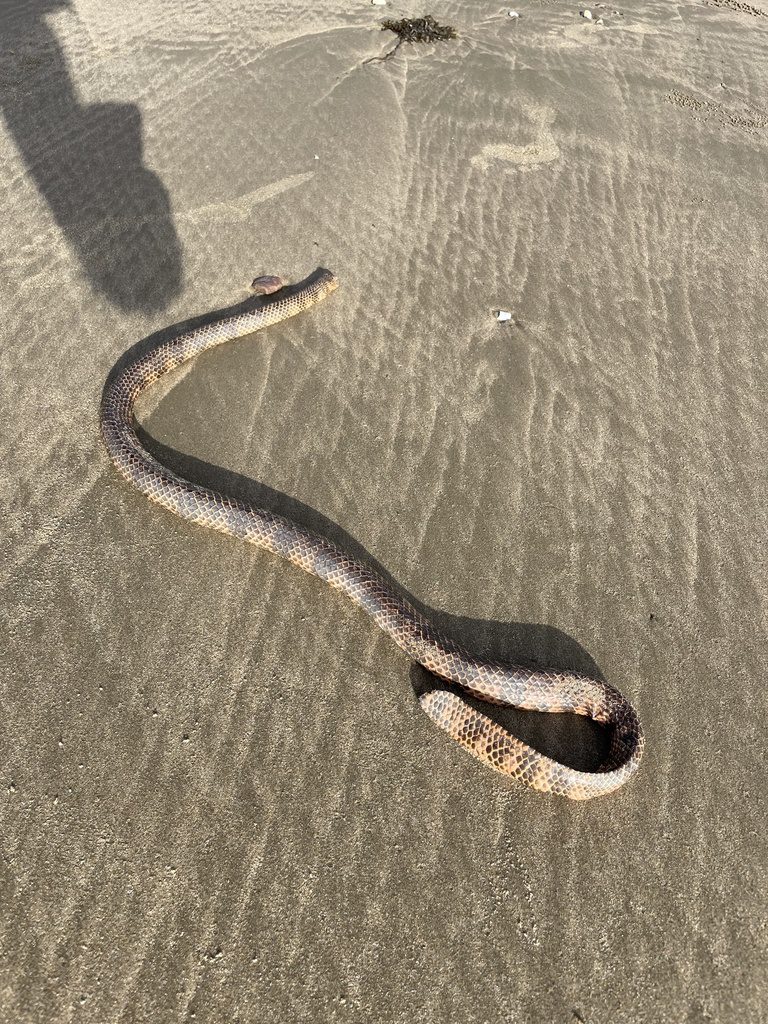
Photo: rcrofts · CC BY 4.0 · iNaturalist
Dubois' Sea Snake
Aipysurus duboisii
Among the most venomous sea snakes measured anywhere — and not reliably tellable from the others in the water.
- Length
- 1–1.5 m
- Active
- Day and night
- Habitat
- Coral and rocky reef, rubble bottoms
- Diet
- Small reef fish, eels
- Status
- Protected wildlife — licensed handlers only
Do not wash the bite, do not apply a tourniquet and do not try to catch the snake. Keep the person still, apply a pressure immobilisation bandage if you have one, and get emergency help immediately.
Native reptiles are protected wildlife. Taking, handling, moving or harming one without the appropriate permit is an offence under Queensland's Nature Conservation Act 1992 and carries significant penalties — as well as being the fastest way to get hurt.
Dubois' Sea Snake is a reef species found along the Queensland coast and one of the most venomous sea snakes measured anywhere in the world.
It is not commonly encountered, and bites are rare. Neither of those facts changes what a bite would mean.
It is a smaller, less conspicuous animal than the Olive Sea Snake it shares reefs with, and is much less likely to approach a diver.
About Dubois' Sea Snake
Adults reach around 1 to 1.5 metres, moderately built, with a body that flattens toward the rear into the standard sea snake paddle tail.
The colour is variable: cream, tan or pale brown, marked with darker brown bands or irregular blotches that are usually widest across the back. Some individuals are strongly patterned and others nearly plain.
The head is small to moderate and not strongly distinct from the neck. There is no single feature that identifies this species in the field with confidence, which is a large part of why sea snakes should not be identified at close range.
Habitat
Where can you find Dubois' Sea Snake?
A reef and hard-bottom species:
- coral reefs and reef flats
- rocky reef and rubble bottoms
- sandy areas adjoining reef
- the Great Barrier Reef and Coral Sea
- coastal reef along the Queensland coast
It shelters in reef structure and forages over hard bottom, generally in shallower water than many of its relatives.
Venom
Is Dubois' Sea Snake dangerous?
Yes — on laboratory toxicity measures this is among the most venomous sea snakes known, and among the most venomous snakes of any kind.
That statistic needs context. Sea snake bites are rare, this species is not commonly encountered, its fangs are short, and it delivers small venom volumes. Recorded bites have generally involved handling. But there is no version of this where a bite is anything other than a medical emergency.
Apply a pressure immobilisation bandage, keep the person absolutely still, and call 000. Sea snake antivenom is effective.
Diet
What does Dubois' Sea Snake eat?
A reef fish specialist:
- small reef fish
- eels
- fish sheltering in coral and rubble
It hunts by working through reef structure, probing holes and crevices in much the same way as the Olive Sea Snake.
Behaviour
What should you know about this species?
Dubois' Sea Snakes surface to breathe and are active both day and night, with more foraging after dark.
Unlike the Olive Sea Snake, this species is not noted for approaching divers, and encounters tend to be brief and uneventful.
It is one of several sea snakes that cannot be reliably told apart in the water by a non-specialist. That is the practical takeaway: on a reef, every sea snake is a dangerously venomous sea snake.
What to do if you see Dubois' Sea Snake
In the water, leave it be and keep your hands to yourself. Do not attempt a closer look for identification purposes.
On a beach, do not touch it and do not attempt to return it to the water. Call us with the location.
If it comes up in fishing gear, do not free it by hand. That is the scenario in which people are bitten.
Asked on
most call-outs.
Is Dubois' Sea Snake really one of the most venomous snakes in the world?
How likely am I to be bitten by one?
How do I tell it apart from other sea snakes?
Where would I encounter one?
What should I do if I am bitten?
Are sea snakes protected?
Call or text — a licensed handler will talk you through it. If someone has been bitten, call 000 first.