
Photo: coenobita · CC BY 4.0 · iNaturalist
Elegant Sea Snake
Hydrophis elegans
Long, slender, tiny-headed and dangerously venomous. The small head is a burrowing tool, not a reassurance.
- Length
- to ~2 m
- Active
- Day and night
- Habitat
- Coastal shallows, estuary mouths, silty bottoms
- Diet
- Eels and burrowing fish
- Status
- Protected wildlife — licensed handlers only
Do not wash the bite, do not apply a tourniquet and do not try to catch the snake. Keep the person still, apply a pressure immobilisation bandage if you have one, and get emergency help immediately.
Native reptiles are protected wildlife. Taking, handling, moving or harming one without the appropriate permit is an offence under Queensland's Nature Conservation Act 1992 and carries significant penalties — as well as being the fastest way to get hurt.
The Elegant Sea Snake is a long, slender, narrow-headed species common in Queensland's coastal and estuarine waters, and one of the sea snakes most often found stranded along the east coast.
It is dangerously venomous. Its small head makes it look harmless in a way that is entirely misleading — it is a large-bodied elapid with the venom to match.
Because it favours turbid inshore water, most people meet it on the sand rather than in the sea.
About the Elegant Sea Snake
This is one of the longer sea snakes in Queensland waters, reaching around two metres, and it is conspicuously slim for its length.
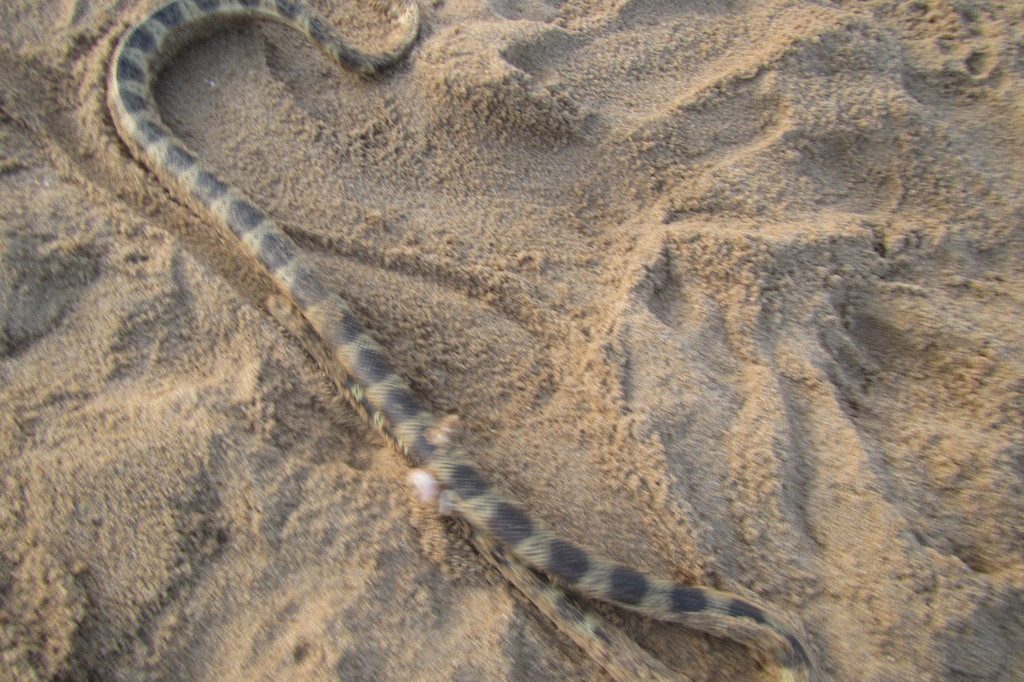
The body is cream to pale yellow or greenish, crossed by dark bands or blotches that are broadest across the back and taper as they run down the flanks. Older animals often fade considerably.
The head is strikingly small and narrow relative to the body — an adaptation for pushing into burrows — and the tail is the usual flattened paddle.
Description
Sea snake or eel?
A stranded sea snake is regularly reported as an eel, and an eel as a sea snake. The differences are clear once you know them, and none require touching anything:
- Scales. A sea snake has obvious overlapping scales. An eel is smooth and slimy.
- Gill slits. Eels have them behind the head; snakes do not.
- Fins. Eels have fins running along the back and tail; snakes have none.
- The tail. A sea snake's tail is a flattened vertical paddle. An eel's tapers into a fin.
- Breathing. Sea snakes must surface for air. Eels do not.
If you are unsure, photograph it from a safe distance and send it to us rather than getting close enough to be certain.
Habitat
Where can you find an Elegant Sea Snake?
This species favours murky, shallow, soft-bottomed water:
- coastal shallows and bays
- estuary mouths and river plumes
- muddy and silty bottoms
- trawl grounds
- stranded on ocean beaches after storms
It is rarely seen by divers simply because the water it prefers is usually too turbid to dive in.
Venom
Is the Elegant Sea Snake dangerous?
Yes. It is dangerously venomous and any bite is a medical emergency, regardless of how small the head looks.
Bites are uncommon and are overwhelmingly associated with handling — netted animals, and stranded animals that someone decided to move.
Apply a pressure immobilisation bandage, keep the person still and call 000.
Diet
What does the Elegant Sea Snake eat?
The narrow head is a specialised tool:
- eels
- burrowing and bottom-dwelling fish
- gobies and similar species
It hunts by pushing its head into burrows and crevices in soft sediment, seizing whatever is inside. The build follows the hunting method exactly.
Behaviour
What should you know about this species?
Elegant Sea Snakes surface regularly to breathe and spend most of their time foraging along the bottom in water too murky for anyone to see them in.
They are not aggressive and have no interest in people. Every realistic risk comes from handling.
Strandings are common after storms, and a stranded animal is helpless — unable to move properly on land, unable to return to the water, and often injured.
What to do if you see an Elegant Sea Snake
Keep back, keep dogs away, and do not touch it. Assume it is alive whatever it looks like.
Do not attempt to return it to the sea. It is stranded for a reason, and handling it is how people are bitten.
Note the location and call us. Sea snakes are protected wildlife and a stranded one is a job for someone licensed and equipped.
Contributed photographs, reused under Creative Commons licences. Colour and pattern vary a lot between individuals — compare several before settling on an ID.
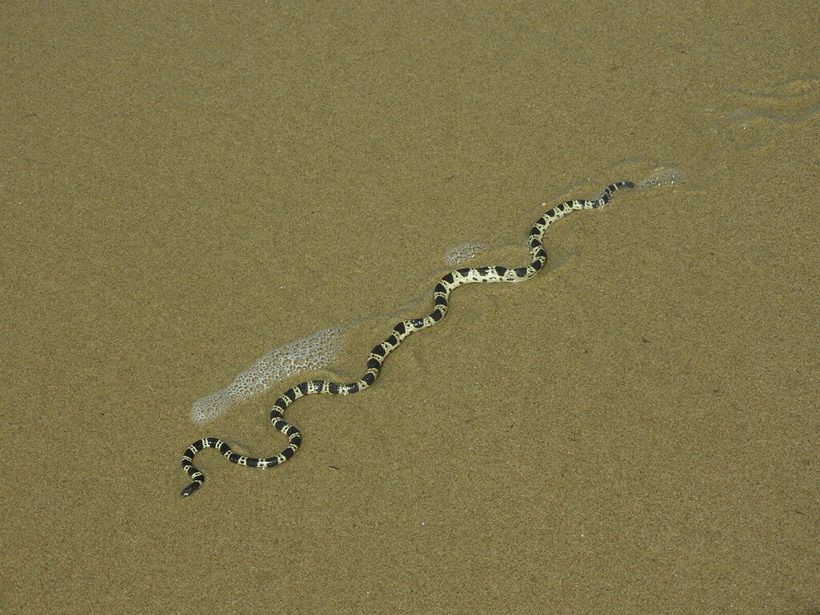
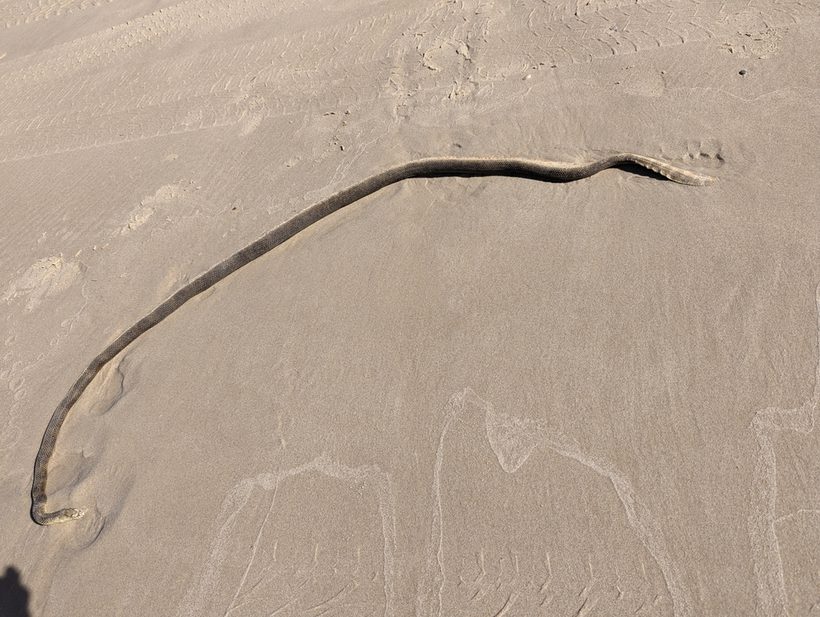
Photo: no rights reserved · CC0 · iNaturalist
Photo: Gary Dickson · CC BY 4.0 · iNaturalist
Asked on
most call-outs.
Is that a sea snake or an eel?
Its head is tiny — is it still dangerous?
Why do I never see them while swimming?
How long do they get?
What should I do if I find one on the beach?
Is it dead if it isn't moving?
Call or text — a licensed handler will talk you through it. If someone has been bitten, call 000 first.