
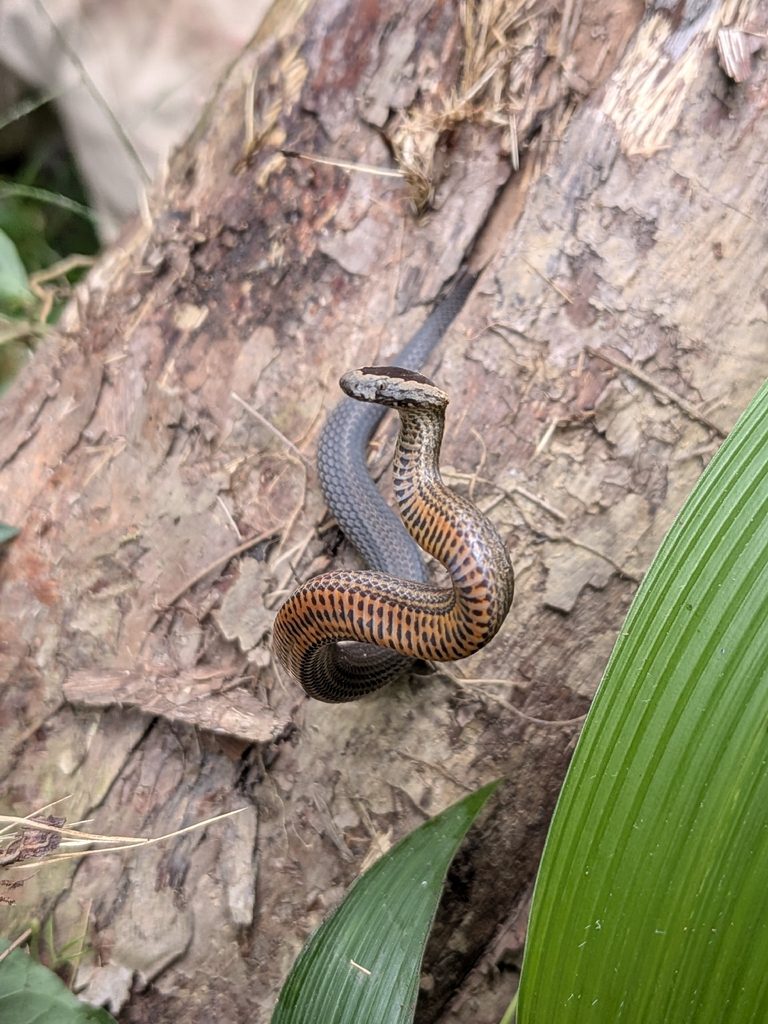
Photo: no rights reserved · CC0 · iNaturalist
Golden-crowned Snake
Cacophis squamulosus
All bluff. Rears up, flattens its neck and mock-strikes with its mouth shut.
- Length
- 50–75 cm
- Active
- Nocturnal
- Habitat
- Gardens, mulch, rainforest, creek gullies
- Diet
- Small skinks and reptile eggs
- Status
- Protected wildlife — licensed handlers only
Compare before you decide. Never act on an identification made from a photo or a guide, including this one.
Do not wash the bite, do not apply a tourniquet and do not try to catch the snake. Keep the person still, apply a pressure immobilisation bandage if you have one, and get emergency help immediately.
Native reptiles are protected wildlife. Taking, handling, moving or harming one without the appropriate permit is an offence under Queensland's Nature Conservation Act 1992 and carries significant penalties — as well as being the fastest way to get hurt.
The Golden-crowned Snake is the larger of the two crowned snakes commonly found in South East Queensland gardens, and a close relative of the Southern Dwarf Crowned Snake covered elsewhere in this guide.
It is weakly venomous and is not considered dangerous to humans, though like all snakes it should be left alone and never handled.
It is best known for its bluff. A disturbed Golden-crowned Snake will rear up dramatically, flatten its neck and make repeated mock strikes — usually without ever opening its mouth.
About the Golden-crowned Snake
Adults typically reach 50 to 75 centimetres, making them noticeably larger than the 25 to 35 centimetre Southern Dwarf Crowned Snake.
The body is dark grey-brown to almost black above. The crown that gives the species its name is a golden or cream band that runs around the back of the head and forward along each side toward the snout, forming an open horseshoe rather than a closed collar.
The belly is pink to cream, usually marked with dark spots or blotches down the centre — a useful point of difference from the plainer belly of its smaller relative.
Habitat
Where can you find a Golden-crowned Snake?
This species likes damp, sheltered ground with plenty to hide under:
- rainforest and wet sclerophyll forest
- creek margins and gullies
- suburban gardens with heavy mulch
- under logs, rocks, pavers and garden debris
- compost heaps and leaf litter
They turn up in gardens regularly, particularly after rain and on warm humid nights. A well-mulched garden bed with a healthy skink population is close to ideal habitat.
Venom
Is the Golden-crowned Snake dangerous?
It is weakly venomous and is not regarded as dangerous to humans. Bites are uncommon and typically produce only local pain and swelling.
Its defensive display is far more impressive than its bite. A cornered animal will raise the front third of its body off the ground, flatten its neck to show the pale underside, and lunge repeatedly at the threat — very often with its mouth closed, effectively headbutting rather than biting.
As with every snake bite in Australia, seek medical assessment. The display is bluff; the identification might be wrong.
Diet
What does the Golden-crowned Snake eat?
The diet is almost entirely reptilian:
- small skinks
- sleeping lizards
- reptile eggs
They hunt at night, when their prey is torpid and easily taken, working through leaf litter and mulch.
Behaviour
What should you know about this species?
Golden-crowned Snakes are nocturnal and spend the day hidden under cover. Most sightings are on warm, humid nights or after heavy rain, when they move about more freely.
They are not aggressive despite the theatrics. The rearing display is a defensive bluff by a small snake with limited options, and given an escape route it will take it.
They are common in South East Queensland, and a garden that hosts one is generally a garden doing something right — mulch, moisture and a healthy lizard population.
What to do if you see a Golden-crowned Snake
Leave it be. It will move on by itself, usually within the night.
Keep pets away — a curious dog or cat is a far bigger threat to the snake than the snake is to them, and cats in particular kill large numbers of small snakes.
If it has ended up somewhere it cannot get out of, or if you are not confident what you are looking at, call a licensed snake catcher rather than attempting to move it.
Contributed photographs, reused under Creative Commons licences. Colour and pattern vary a lot between individuals — compare several before settling on an ID.
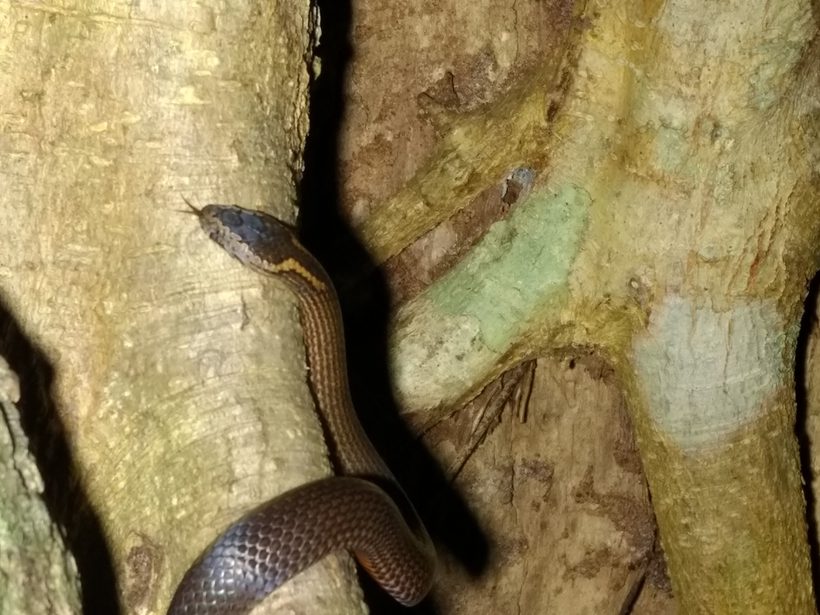
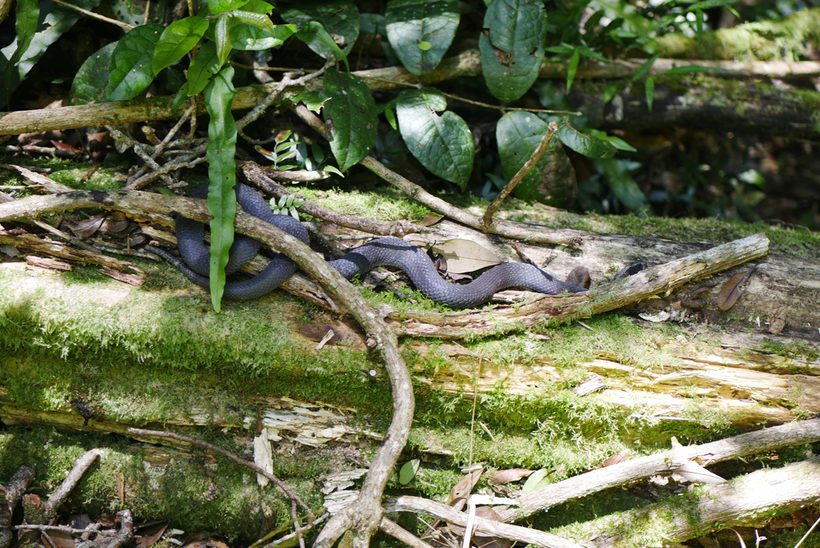
Photo: Nigel Main · CC BY 4.0 · iNaturalist
Photo: Lucas Christofides · CC BY 4.0 · iNaturalist
Asked on
most call-outs.
How do you identify a Golden-crowned Snake?
How is it different from a Southern Dwarf Crowned Snake?
Is the Golden-crowned Snake venomous?
Why did it rear up at me?
Why do I find them in my garden after rain?
Will it hurt my dog or cat?
Call or text — a licensed handler will talk you through it. If someone has been bitten, call 000 first.