
Photo: dhfischer · CC BY 4.0 · iNaturalist
Red-naped Snake
Furina diadema
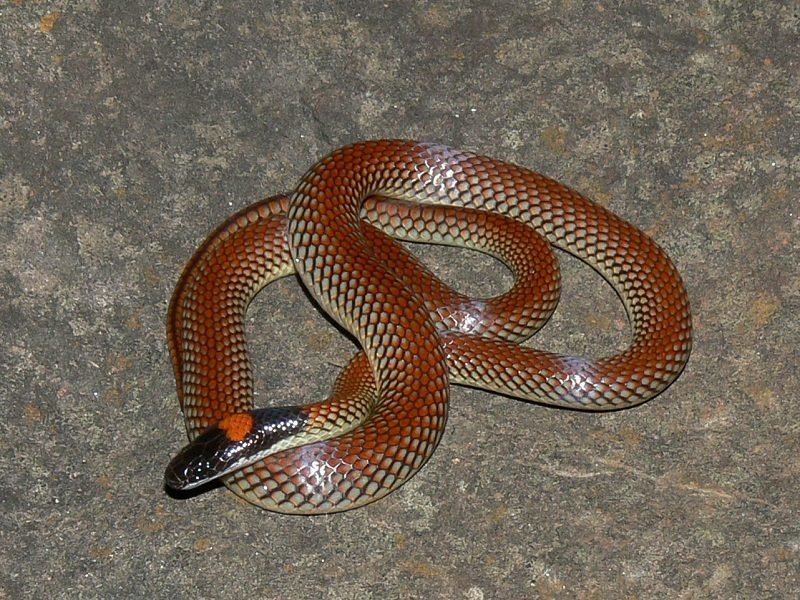
Glossy black head, bright red nape patch. Nothing else that size looks like it.
- Length
- 30–40 cm
- Active
- Nocturnal
- Habitat
- Dry woodland, rocky ground, mulched beds
- Diet
- Small skinks and reptile eggs
- Status
- Protected wildlife — licensed handlers only
Compare before you decide. Never act on an identification made from a photo or a guide, including this one.
Do not wash the bite, do not apply a tourniquet and do not try to catch the snake. Keep the person still, apply a pressure immobilisation bandage if you have one, and get emergency help immediately.
Native reptiles are protected wildlife. Taking, handling, moving or harming one without the appropriate permit is an offence under Queensland's Nature Conservation Act 1992 and carries significant penalties — as well as being the fastest way to get hurt.
The Red-naped Snake is a small, striking nocturnal species found through South East Queensland. It is easily recognised by its glossy black head and the bright orange-red patch across the back of the neck that gives it its name.
It is weakly venomous and is not considered dangerous to humans.
It is secretive and rarely seen in the open, though it turns up in gardens often enough — usually under something, or crossing a path on a warm wet night.
About the Red-naped Snake
This is a slender, small species, usually between 30 and 40 centimetres, occasionally a little larger.
The body is reddish-brown to grey-brown, and each scale is often finely edged in a darker shade, giving a subtle patterned effect at close range. The belly is white or cream.
The head is glossy black, distinctly darker than the body, and immediately behind it sits a bright orange to red patch across the nape. That combination — black head, red nape, reddish-brown body — is not shared by anything else of this size in the region.
Habitat
Where can you find a Red-naped Snake?
This species prefers drier country than the crowned snakes, but overlaps with them widely:
- open woodland and dry forest
- grassland and rocky ground
- under rocks, logs and fallen bark
- suburban gardens and mulched beds
- cracks in dry soil
They shelter by day and are most often found by someone lifting a rock or a piece of timber. On warm nights, particularly after rain, they move about and are sometimes seen on paths and driveways.
Venom
Is the Red-naped Snake dangerous?
It is weakly venomous and is not considered dangerous to humans. The mouth is very small and bites are rare, with any effects generally limited to the bite site.
Like the crowned snakes it shares its habitat with, it defends itself with display rather than force — raising the forebody in a loop and striking out, often without connecting or without opening its mouth.
Every snake bite in Australia should still be medically assessed.
Diet
What does the Red-naped Snake eat?
This species is a lizard specialist:
- small skinks
- sleeping lizards
- reptile eggs
It hunts at night by searching through litter and under cover for inactive lizards.
Behaviour
What should you know about this species?
Red-naped Snakes are nocturnal and secretive, and spend the great majority of their lives out of sight under cover.
They are inoffensive and pose no meaningful threat to people or pets. Their defensive display, like the crowned snakes', is bluff from a small animal with very little else available to it.
Because they are small, dark-headed and quick to disappear, they are regularly reported as something more serious. A photograph almost always settles it.
What to do if you see a Red-naped Snake
Leave it alone and it will be gone by morning. Replace whatever you lifted and let it settle.
Keep pets clear, more for the snake's sake than yours.
If you are unsure what you have found — and small snakes are exactly where identification goes wrong — send us a photo taken from a safe distance rather than handling it to get a better look.
Contributed photographs, reused under Creative Commons licences. Colour and pattern vary a lot between individuals — compare several before settling on an ID.
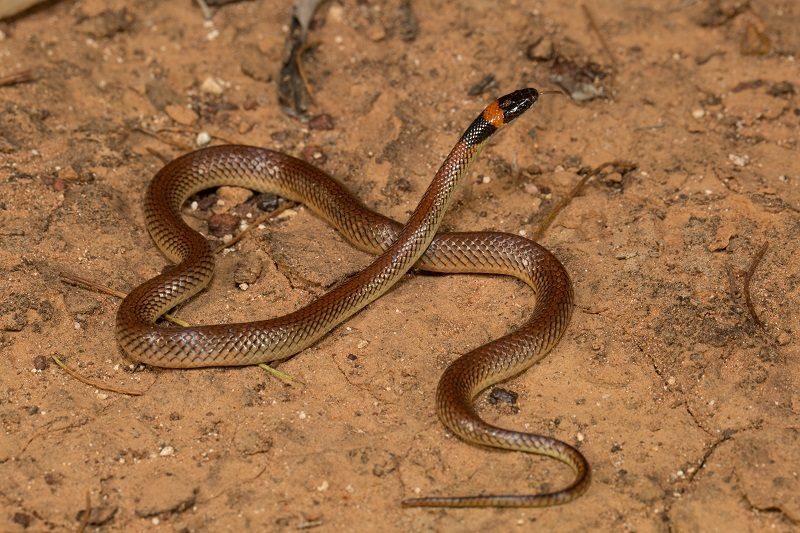
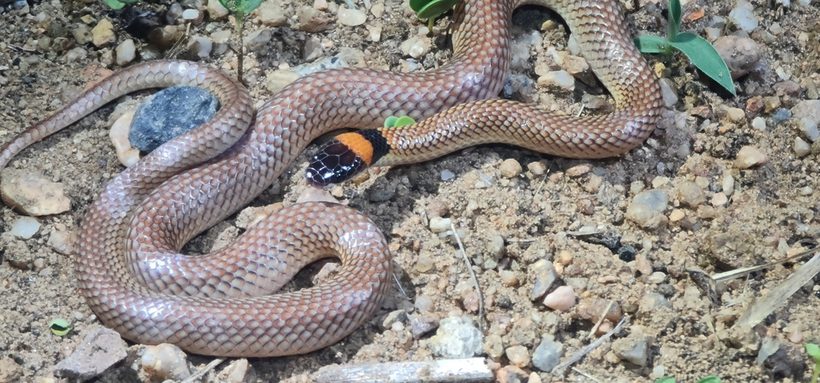
Photo: dhfischer · CC BY 4.0 · iNaturalist
Photo: no rights reserved · CC0 · iNaturalist
Asked on
most call-outs.
How do you identify a Red-naped Snake?
Is the Red-naped Snake venomous?
Could I mistake it for something dangerous?
Where would I find one?
Do they eat anything I care about?
Should I have it removed?
Call or text — a licensed handler will talk you through it. If someone has been bitten, call 000 first.