
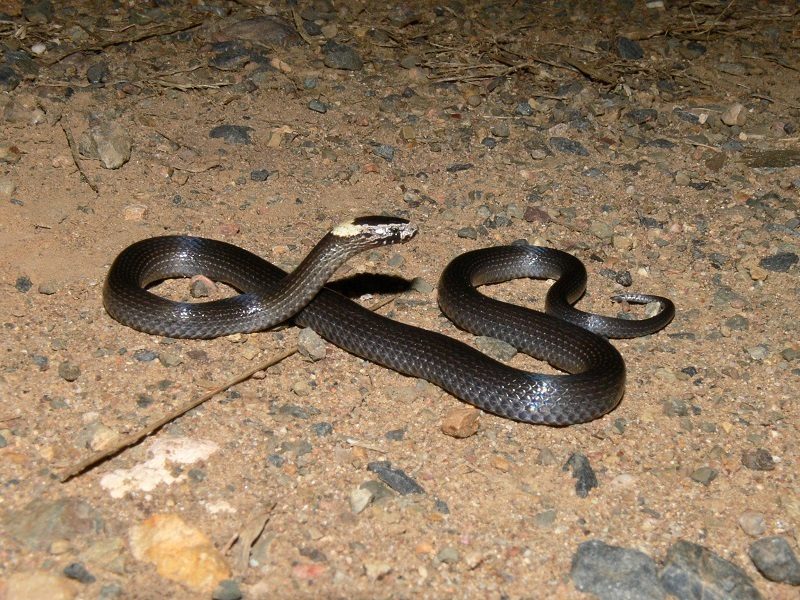
Photo: dhfischer · CC BY 4.0 · iNaturalist
White-crowned Snake
Cacophis harriettae
Probably the most common snake in a Sunshine Coast garden, and the least often noticed.
- Length
- ~40 cm
- Active
- Nocturnal
- Habitat
- Suburban gardens, under pots, pavers and mulch
- Diet
- Small skinks
- Status
- Protected wildlife — licensed handlers only
Compare before you decide. Never act on an identification made from a photo or a guide, including this one.
Do not wash the bite, do not apply a tourniquet and do not try to catch the snake. Keep the person still, apply a pressure immobilisation bandage if you have one, and get emergency help immediately.
Native reptiles are protected wildlife. Taking, handling, moving or harming one without the appropriate permit is an offence under Queensland's Nature Conservation Act 1992 and carries significant penalties — as well as being the fastest way to get hurt.
The White-crowned Snake is a small, dark, nocturnal snake and one of the most common species found in South East Queensland suburban gardens. Many people who have never knowingly seen a snake in their yard have one living in it.
It is weakly venomous and is not considered dangerous to humans.
Like its crowned relatives, it defends itself with a display rather than a bite — rearing up, flattening its neck and mock-striking at whatever has disturbed it.
About the White-crowned Snake
This is a small species, usually around 40 centimetres and rarely exceeding 50. The body is slender and the head is barely distinct from the neck.
The upper surface is a uniform dark grey to black. The distinguishing feature is a broad white or cream collar that crosses the nape and continues forward along the sides of the head, more strongly marked and more complete than the crown of the Golden-crowned Snake.
The belly is uniform grey, without the pink tones or dark spotting seen on its relatives.
Habitat
Where can you find a White-crowned Snake?
This species has adapted well to gardens and is often found close to houses:
- suburban gardens and mulched beds
- rainforest and wet forest
- under pavers, pot plants and garden edging
- rockeries, retaining walls and timber
- compost heaps and leaf litter
They are frequently turned up while gardening — under a pot that has not been moved for a while, or in the mulch of a shaded bed. On warm wet nights they move about in the open and are sometimes found on paths and driveways.
Venom
Is the White-crowned Snake dangerous?
It is weakly venomous and not considered dangerous to humans. Its mouth is small, and bites are rare and minor.
Its defensive routine is pure theatre. Disturbed animals rear the forebody up off the ground, flatten the neck, and strike out repeatedly — frequently with the mouth closed. The performance is out of all proportion to the animal's actual capability, which is the point of it.
Any snake bite should still be looked at by a medical professional, if only because identifications made in the dark by the person who was bitten are not reliable.
Diet
What does the White-crowned Snake eat?
Small lizards make up essentially the whole diet:
- small skinks
- sleeping lizards
- occasionally reptile eggs
They hunt at night through leaf litter and mulch, taking lizards that are inactive and easily caught after dark.
Behaviour
What should you know about this species?
White-crowned Snakes are strictly nocturnal and highly secretive. They spend the day under cover and emerge after dark, particularly in warm humid weather.
They are inoffensive animals that would much rather leave than fight, and their entire defensive strategy is to look like more trouble than they are worth.
They are also a good sign. A garden supporting a White-crowned Snake is supporting a skink population, which in turn means invertebrates, mulch and shelter — a functioning small ecosystem in a suburban block.
What to do if you see a White-crowned Snake
Nothing, in most cases. Put the pot or paver back where it was, give the snake a night to relocate itself, and carry on.
Keep cats indoors at night if you can. Cats are by far the biggest cause of death for small snakes like this one in suburban areas.
If you cannot confirm what you are looking at — and small dark snakes are genuinely difficult — photograph it from a safe distance and send it to us rather than guessing.
Asked on
most call-outs.
How do you identify a White-crowned Snake?
How is it different from a Golden-crowned Snake?
Is the White-crowned Snake dangerous?
Why does it rear up and strike at me?
I keep finding them under pot plants — why?
Should I have it removed?
Call or text — a licensed handler will talk you through it. If someone has been bitten, call 000 first.