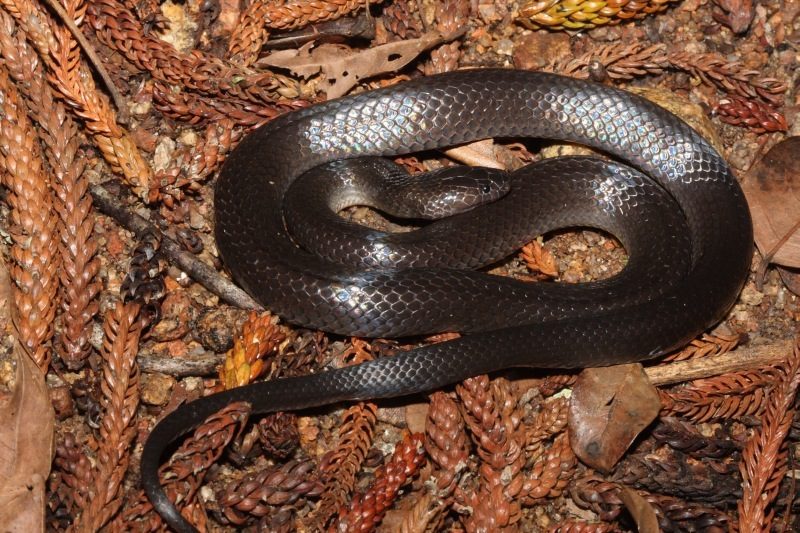
Photo: dhfischer · CC BY 4.0 · iNaturalist
Eastern Small-eyed Snake
Cryptophis nigrescens
Small, glossy black and badly underestimated. The venom damages muscle, and it has killed.
- Length
- ~50 cm, to ~1 m
- Active
- Nocturnal
- Habitat
- Under sheet iron, logs, rocks, garden debris
- Diet
- Small skinks, geckos, reptile eggs
- Status
- Protected wildlife — licensed handlers only
Compare before you decide. Never act on an identification made from a photo or a guide, including this one.
Do not wash the bite, do not apply a tourniquet and do not try to catch the snake. Keep the person still, apply a pressure immobilisation bandage if you have one, and get emergency help immediately.
Native reptiles are protected wildlife. Taking, handling, moving or harming one without the appropriate permit is an offence under Queensland's Nature Conservation Act 1992 and carries significant penalties — as well as being the fastest way to get hurt.
The Eastern Small-eyed Snake is a small, glossy black snake that is easy to underestimate and should not be. Its venom is myotoxic — it damages muscle tissue — and it has been responsible for a human death in Australia.
It is common through South East Queensland and is often turned up under sheet iron, logs and garden debris. Because it is small and dark, it is regularly mistaken for a juvenile Red-bellied Black Snake or a Marsh Snake.
This is a species where size is a poor guide to risk.
About the Eastern Small-eyed Snake
Adults are usually around 50 centimetres, occasionally reaching close to 1 metre. The body is slender and the head is barely distinct from the neck.
The upper surface is a uniform glossy black, often with a blue or purplish sheen in good light. The belly is cream, pink or coral red, and the colour does not extend up the flanks the way it does on a Red-bellied Black Snake.
The name is accurate and useful: the eye is genuinely small relative to the head, noticeably smaller than that of the similar-looking species it gets confused with.
Habitat
Where can you find an Eastern Small-eyed Snake?
This is a secretive, shelter-loving species found in a wide range of habitats:
- open forest and woodland
- rainforest margins
- rocky outcrops and scree
- under sheet iron, timber and rubbish piles
- gardens, sheds and around building foundations
They spend the day hidden and are most often found by people moving something — lifting a sheet of iron, shifting a woodpile, turning over pavers. That is worth knowing before you start tidying up around a shed.
Venom
Is the Eastern Small-eyed Snake dangerous?
Yes, despite its size. The venom is strongly myotoxic and can cause serious muscle damage, which in turn can affect the kidneys. A fatality has been recorded in Australia from this species.
Symptoms may be slow to develop, which adds to the danger — someone bitten by a small black snake can easily assume nothing much has happened. It has not necessarily.
Treat any bite as a medical emergency. Apply a pressure immobilisation bandage, keep the person still and call 000, regardless of how small the snake was.
Diet
What does the Eastern Small-eyed Snake eat?
This species feeds almost entirely on other reptiles:
- small skinks
- geckos
- other small lizards
- reptile eggs
- occasionally small snakes
It hunts at night, working through leaf litter and under cover where sleeping lizards can be found.
Behaviour
What should you know about this species?
Eastern Small-eyed Snakes are nocturnal and secretive, spending daylight hours under cover. They are not usually aggressive and will generally try to escape rather than confront.
The risk comes from the circumstances of most encounters. People meet this species by uncovering it unexpectedly, at close range, with bare hands already in the wrong place.
They are also known to shelter communally under good cover, so finding one does not mean there is only one.
What to do if you see an Eastern Small-eyed Snake
Put down whatever you have lifted, step back, and give it room to leave.
Do not assume a small black snake is harmless, and do not attempt to move it — this species accounts for a genuine share of serious bites precisely because it looks unthreatening.
If it needs relocating from around a house or shed, call a licensed snake catcher. When clearing sheet iron, timber or rubbish around a property, wear boots and gloves and use a rake rather than your hands.
Contributed photographs, reused under Creative Commons licences. Colour and pattern vary a lot between individuals — compare several before settling on an ID.
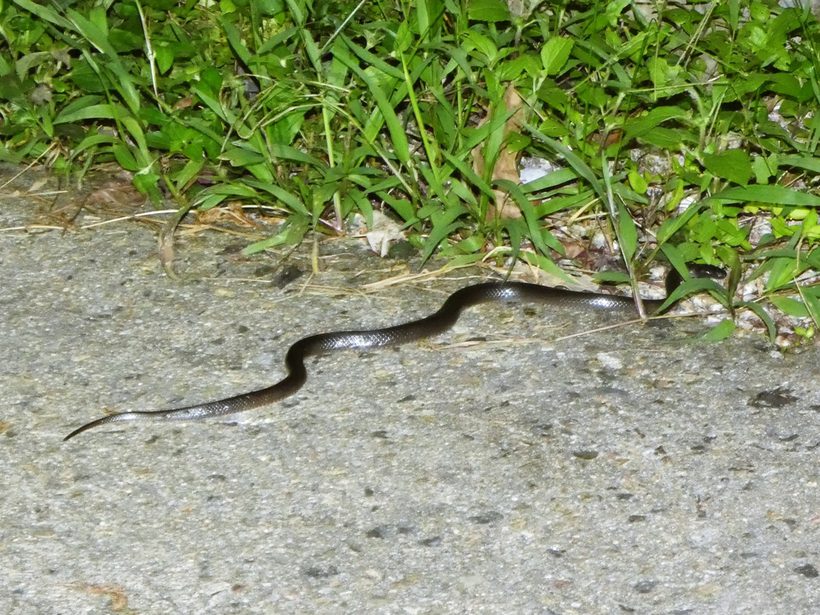
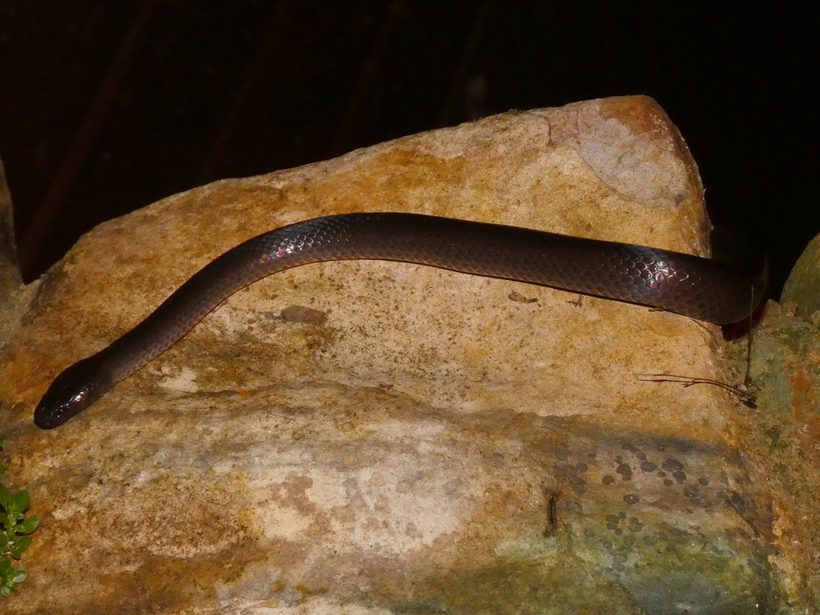
Photo: Kai Squires · CC BY 4.0 · iNaturalist
Photo: Kai Squires · CC BY 4.0 · iNaturalist
Asked on
most call-outs.
How do you identify an Eastern Small-eyed Snake?
Is it just a baby Red-bellied Black Snake?
How dangerous is a bite?
Where am I most likely to find one?
How do I avoid meeting one while cleaning up?
Are they aggressive?
Call or text — a licensed handler will talk you through it. If someone has been bitten, call 000 first.