
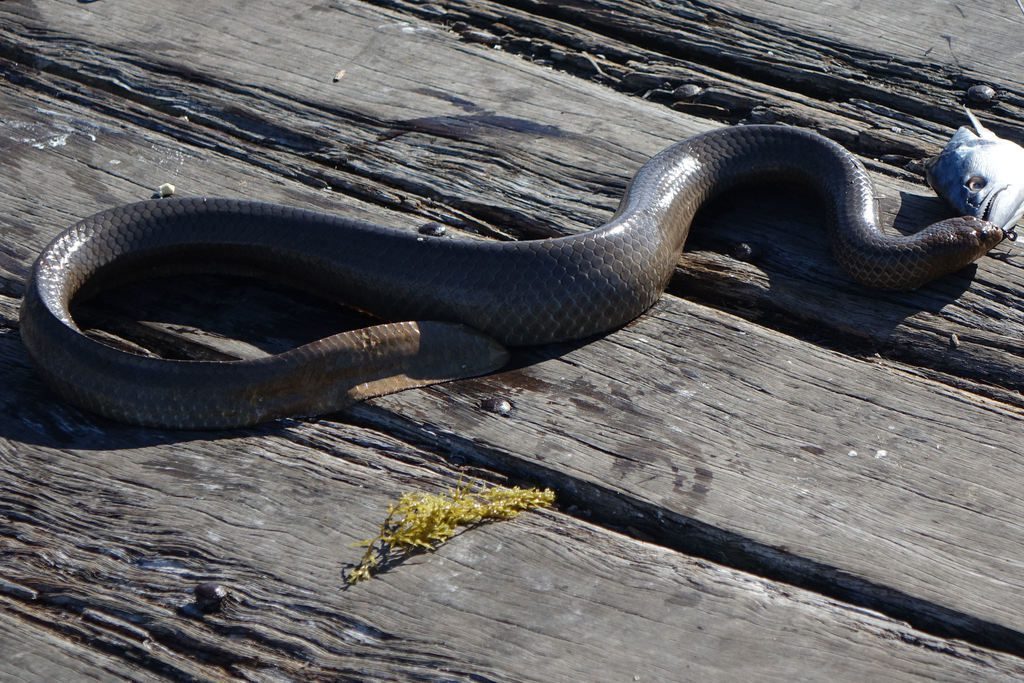
Photo: John Barkla · CC BY 4.0 · iNaturalist
Olive Sea Snake
Aipysurus laevis
The one that swims up to look at you. Curiosity, not a charge — but dangerously venomous all the same.
- Length
- 1.5–2 m
- Active
- Day and night
- Habitat
- Coral and rocky reef, Coral Sea, GBR
- Diet
- Reef fish, prawns, crabs
- Status
- Protected wildlife — licensed handlers only
Compare before you decide. Never act on an identification made from a photo or a guide, including this one.
Do not wash the bite, do not apply a tourniquet and do not try to catch the snake. Keep the person still, apply a pressure immobilisation bandage if you have one, and get emergency help immediately.
Native reptiles are protected wildlife. Taking, handling, moving or harming one without the appropriate permit is an offence under Queensland's Nature Conservation Act 1992 and carries significant penalties — as well as being the fastest way to get hurt.
The Olive Sea Snake is the sea snake divers and snorkellers in Queensland are most likely to meet, and the one most likely to swim straight up and look at them.
It is large, heavy-bodied and dangerously venomous. It is also genuinely curious, and that combination produces a great many alarming stories and very few bites.
A snake that approaches you underwater is investigating, not attacking. What it does next depends almost entirely on what you do next.
About the Olive Sea Snake
Adults commonly reach 1.5 to 2 metres and are thickset, with a body that is round toward the front and increasingly flattened toward the rear.
Colour ranges from olive-brown through purplish-brown to deep chocolate, and many individuals have paler scale centres that give a subtly mottled or freckled look. The underside is cream to pale yellow.
The head is relatively small and rounded and blends smoothly into the body. The tail is a broad, flattened paddle — the single feature that separates every sea snake from every land snake.
Habitat
Where can you find an Olive Sea Snake?
This is a reef species and stays close to structure:
- coral reefs and reef flats
- rocky reef and bommies
- the Great Barrier Reef and Coral Sea
- coastal reef systems down the Queensland coast
- occasionally washed ashore after storms
They shelter in coral crevices and under ledges and forage over the reef, returning to the surface to breathe every half hour or so.
Venom
Is the Olive Sea Snake dangerous?
Yes. Sea snake venom is powerfully neurotoxic and myotoxic, and this species is dangerously venomous. Any bite is a medical emergency.
Bites are nonetheless rare, and almost all involve fishers handling netted animals or people grabbing at one. Divers who stay still and let a curious snake finish its inspection are very rarely bitten.
If one approaches, do not thrash, do not swat at it, and do not swim away in a panic — sudden movement is what turns curiosity into a defensive reaction. Stay calm, keep your hands close, and let it move on.
Diet
What does the Olive Sea Snake eat?
It forages by probing coral crevices, largely by feel:
- small reef fish
- prawns and shrimp
- crabs
- fish eggs, occasionally
Much of its hunting happens with its head pushed into holes it cannot see into, which is part of why it investigates unfamiliar objects — including divers — so readily.
Behaviour
What should you know about this species?
Olive Sea Snakes are active by day and night and must surface to breathe, though they can remain submerged for long periods — this species absorbs a significant share of its oxygen directly through its skin.
The famous approach behaviour is best understood as curiosity and, in the breeding season, males mistaking a diver for another snake. It looks like a charge and is not one.
They are also declining in parts of their range, and reef sea snake populations are a subject of active research concern.
What to do if you see an Olive Sea Snake
In the water: stay still, keep your hands in, and let it look. Do not touch it, and do not try to push it away with a camera or a fin.
On a beach: do not touch it at all. A stranded sea snake cannot move properly on land, often looks dead when it is not, and can still bite.
If you are fishing and one comes up in a net or on a line, do not attempt to free it by hand. Call us — sea snakes are protected wildlife and this is exactly the situation where people get bitten.
Contributed photographs, reused under Creative Commons licences. Colour and pattern vary a lot between individuals — compare several before settling on an ID.
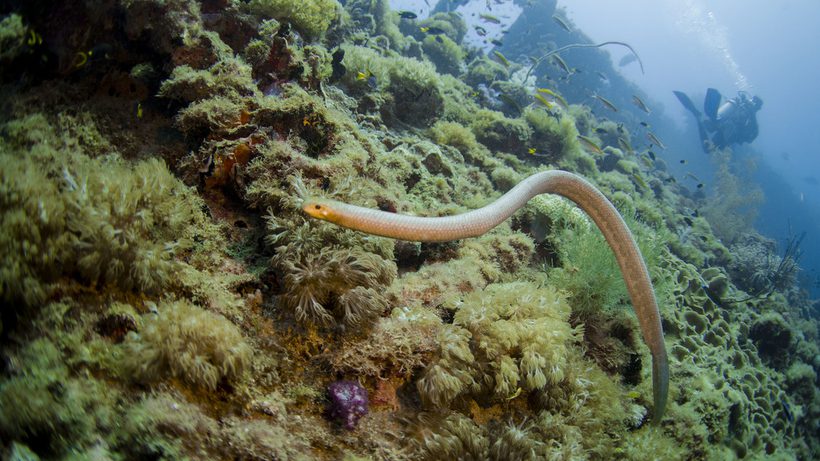
Photo: Christopher Mark · CC BY 4.0 · iNaturalist
Asked on
most call-outs.
Why did a sea snake swim straight at me?
What should I do if one approaches me underwater?
How do I know it is a sea snake and not an eel?
Is the Olive Sea Snake dangerous?
One came up in my net — how do I get it out?
How long can they stay underwater?
Call or text — a licensed handler will talk you through it. If someone has been bitten, call 000 first.