
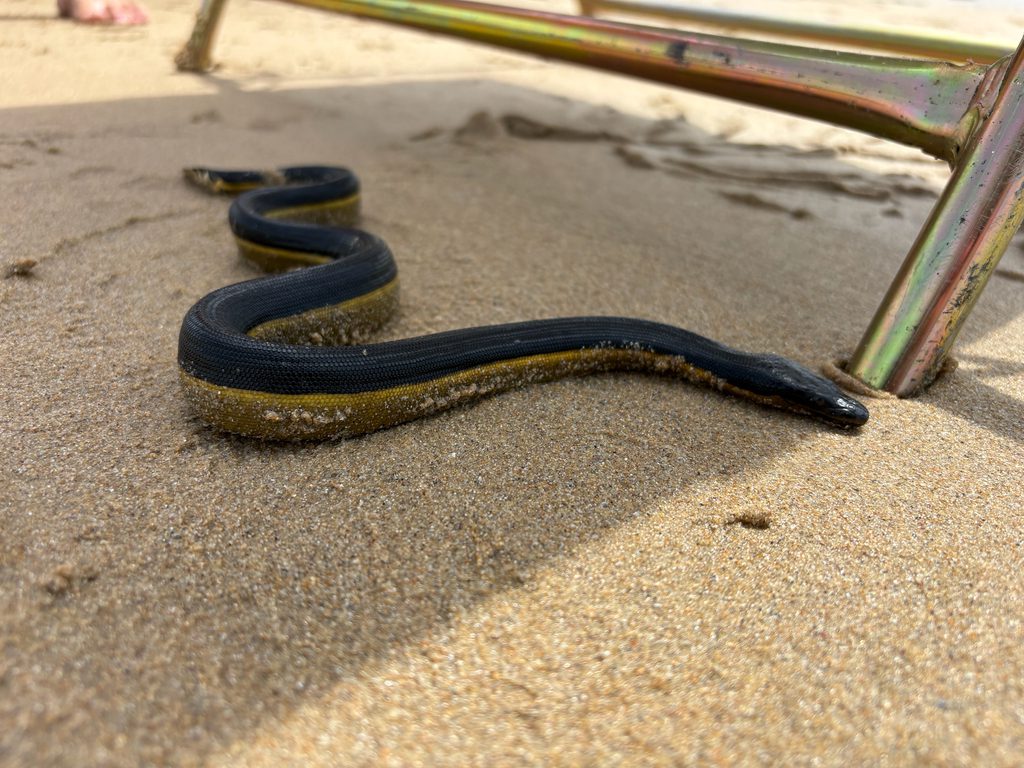
Photo: Bryce Watts-Parker · CC BY 4.0 · iNaturalist
Yellow-bellied Sea Snake
Hydrophis platurus
Black above, yellow below, paddle tail. Turns up on SEQ beaches after storms — looking dead, and not being dead.
- Length
- 70 cm – 1 m
- Active
- Open ocean
- Habitat
- Pelagic; washes ashore after storms
- Diet
- Small fish and fish larvae
- Status
- Protected wildlife — licensed handlers only
Do not wash the bite, do not apply a tourniquet and do not try to catch the snake. Keep the person still, apply a pressure immobilisation bandage if you have one, and get emergency help immediately.
Native reptiles are protected wildlife. Taking, handling, moving or harming one without the appropriate permit is an offence under Queensland's Nature Conservation Act 1992 and carries significant penalties — as well as being the fastest way to get hurt.
The Yellow-bellied Sea Snake is the one snake in this guide you are most likely to meet at the beach rather than in the backyard. It is a fully marine, open-ocean species that never comes ashore by choice — and washes up on South East Queensland beaches after storms and strong onshore winds.
It is dangerously venomous. It is also, when stranded, completely helpless, and that combination is exactly why people get hurt: a sea snake lying motionless on the sand looks dead, and is often picked up.
If you find one on the beach, do not touch it. Call us.
About the Yellow-bellied Sea Snake
This species is unmistakable and needs no close inspection to identify. The body is sharply two-toned along its whole length: dark brown or black above, bright yellow below, with the division running as a clean horizontal line from head to tail.
Adults are usually 70 centimetres to a metre. The body is laterally compressed — flattened side to side like an oar blade rather than round — and the tail is a broad, flat paddle, often marked with black bars or blotches on yellow.
The head is narrow and elongated, dark on top and yellow beneath, with the nostrils set high on the snout for breathing at the surface.
Habitat
Where can you find a Yellow-bellied Sea Snake?
This is a pelagic species — it lives in the open ocean rather than on reefs or in estuaries. It has the widest distribution of any snake on earth, across the Indian and Pacific Oceans.
In South East Queensland you will encounter one in only one situation:
- washed up on ocean beaches after storms, cyclones or sustained onshore winds
- occasionally in drift lines and among floating debris close inshore
They gather at ocean surface slicks where currents concentrate floating debris and small fish. Weather that breaks up those slicks and pushes them shoreward is what strands them.
Venom
Is the Yellow-bellied Sea Snake dangerous?
Yes. Sea snake venom is powerfully neurotoxic and myotoxic, and this species is dangerously venomous. Bites in Australia are rare, but that is a function of how rarely people and this snake are in the same place — not of the snake being harmless.
The specific danger with a stranded animal is that it appears dead. A sea snake out of water cannot move properly, cannot escape and often lies completely still. It can still bite, and its fangs are perfectly capable of penetrating skin.
Never pick one up, never attempt to return it to the water, and keep dogs well away. If bitten, apply a pressure immobilisation bandage, keep still and call 000.
Diet
What does the Yellow-bellied Sea Snake eat?
This species feeds at the ocean surface, ambushing prey that gathers around floating debris:
- small fish
- fish larvae
- juvenile fish sheltering in surface slicks
It hunts by floating motionless among the debris and striking sideways at fish that approach — an efficient strategy that requires the snake to do almost nothing.
Behaviour
What should you know about this species?
Yellow-bellied Sea Snakes spend their entire lives at sea and give birth to live young in the water. They never need to come ashore, and unlike some sea snakes they cannot move effectively on land at all.
They can remain submerged for extended periods, absorbing a meaningful share of their oxygen straight through the skin, and dive well below the surface between breaths.
A stranded animal is in serious trouble. It is exhausted, often injured by surf, and cannot return to the water under its own power. It is not being aggressive by staying still — it has no other option.
What to do if you see a Yellow-bellied Sea Snake
Keep back, keep children and dogs well away, and do not touch it under any circumstances — including with a stick or a towel.
Do not try to put it back in the sea. A stranded sea snake is usually stranded because something is wrong with it, and handling it puts you within range of a dangerously venomous animal that cannot flee.
Note the location and call us. Sea snakes are protected wildlife, and a stranded one is a rescue job for someone licensed and equipped for it.
Contributed photographs, reused under Creative Commons licences. Colour and pattern vary a lot between individuals — compare several before settling on an ID.
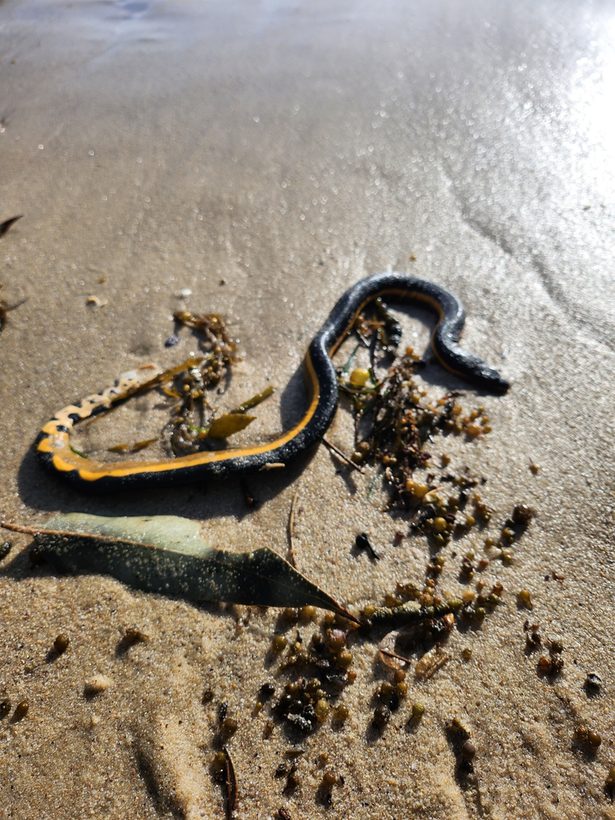
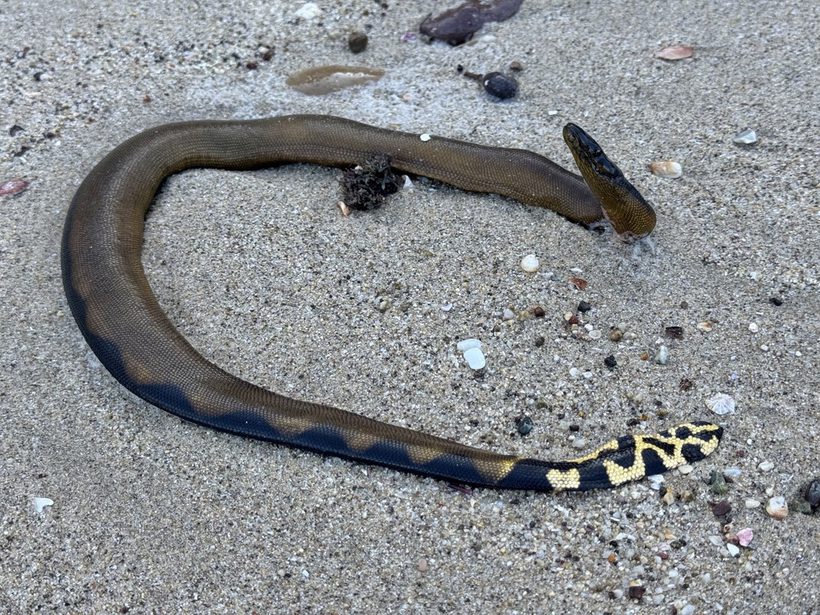
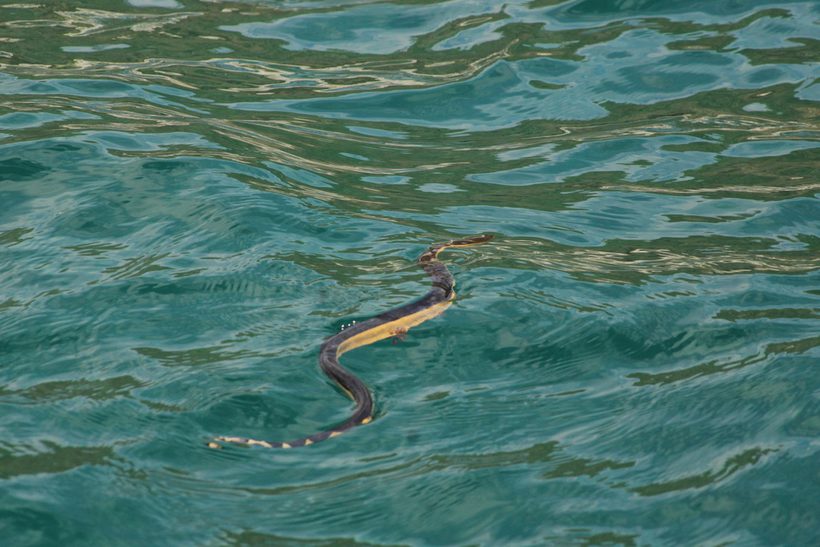
Photo: no rights reserved · CC0 · iNaturalist
Photo: no rights reserved · CC0 · iNaturalist
Photo: Carlos Domínguez-Rodríguez · CC BY 4.0 · iNaturalist
Asked on
most call-outs.
How do you identify a Yellow-bellied Sea Snake?
Why is it on the beach?
It looks dead — can I move it?
Is a sea snake bite dangerous?
Are they aggressive?
What should I do if my dog finds one?
Call or text — a licensed handler will talk you through it. If someone has been bitten, call 000 first.