
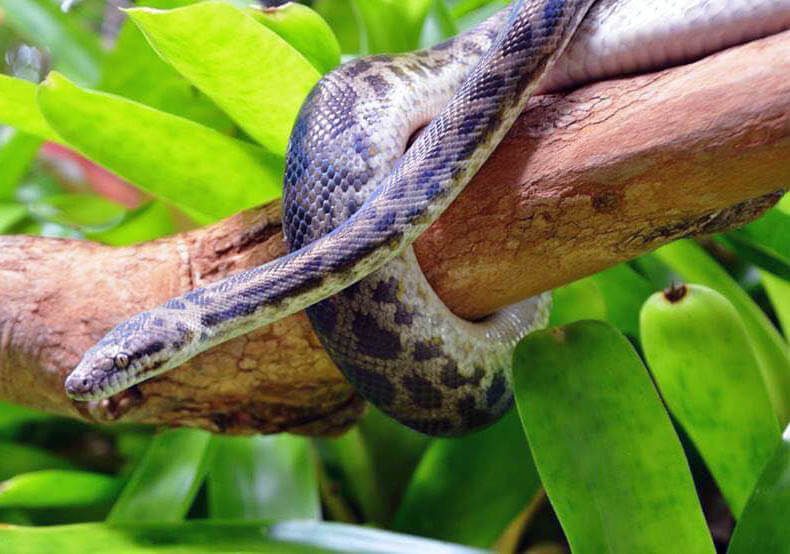
Spotted Python
Antaresia maculosa
A compact, even-tempered python that hunts bats mid-air off cave ledges — and turns up in pool pump covers.
- Length
- 1–1.4 m
- Active
- Nocturnal
- Habitat
- Dry woodland, rock walls, garages, wood piles
- Diet
- Small lizards, birds, small mammals, bats
- Status
- Protected wildlife — licensed handlers only
Do not wash the bite, do not apply a tourniquet and do not try to catch the snake. Keep the person still, apply a pressure immobilisation bandage if you have one, and get emergency help immediately.
Native reptiles are protected wildlife. Taking, handling, moving or harming one without the appropriate permit is an offence under Queensland's Nature Conservation Act 1992 and carries significant penalties — as well as being the fastest way to get hurt.
The Spotted Python is one of the smaller python species found along Australia’s eastern coastline. Although not as large as the Coastal Carpet Python, this species is still commonly encountered across Queensland and occasionally turns up around homes, sheds, and gardens.
Spotted pythons are non-venomous, relatively docile snakes that play an important role in controlling small pest animals. Because of their manageable size and calm temperament, they are also one of the more commonly kept python species in captivity.
About the Spotted Python
Spotted Pythons are a small but solidly built python species that typically grow between 1 metre and 1.4 metres in length. Their bodies are usually olive-brown or light brown with darker blotches scattered across the back and sides. Despite the name “spotted python,” these markings are often more irregular blotches rather than perfectly round spots.
They have a pale cream or light-coloured belly and a distinct head that is slightly wider than the neck. Compared with larger python species such as the Coastal Carpet Python, they are much more compact but still powerful constrictors.
These snakes are generally known for their calm behaviour and will usually try to avoid confrontation when encountered.
Habitat
Where can you find a Spotted Python?
Spotted Pythons occur across northern and eastern Australia, ranging from Cape York in Queensland down to northern New South Wales.
They occupy a wide range of habitats including:
- dry woodland
- open forest
- rocky outcrops and escarpments
- riverbanks
- caves and cliff systems
In urban environments they may occasionally be found around houses and gardens where good hiding places exist. Common hiding locations include garages, wood piles, pool pump covers, rock walls, and other sheltered areas.
Venom
Is the Spotted Python dangerous?
The Spotted Python is not venomous. Like all pythons, it kills its prey using constriction, wrapping around the animal and squeezing until it can no longer breathe.
Although not considered dangerous to humans, any snake may bite if it feels threatened. Spotted pythons have rows of sharp teeth used to grip prey, and a defensive bite can still cause puncture wounds or lacerations.
For this reason, wild snakes should never be handled by unlicensed or inexperienced people.
Diet
What does the Spotted Python eat?
Spotted Pythons are nocturnal hunters and feed on a variety of small animals.
Typical prey includes:
- small lizards
- birds
- small mammals
- bats
Juveniles often start by feeding primarily on small reptiles, while larger adults shift toward mammals and birds.
One of the more unusual hunting behaviours of this species occurs in caves and rocky areas where bats roost. Spotted pythons may hang from rock ledges or tree branches and grab bats as they fly past, catching them mid-air before constricting them.
Behaviour
What should you know about this species?
Spotted Pythons are generally semi-arboreal, meaning they spend time both on the ground and in trees. They are strong climbers and may be found in branches, roof spaces, or elevated hiding spots.
They are usually active at night when they leave their shelter to hunt. During the day they tend to remain hidden beneath rocks, logs, debris, or inside cavities.
Compared to many other snake species, spotted pythons are typically calm and non-aggressive, though they will still defend themselves if provoked.
What to do if you see a Spotted Python
If you encounter a spotted python in your yard or home, the best approach is to leave the snake alone and keep a safe distance.
Keep pets and children away and allow the snake an opportunity to move off on its own. If the snake remains in the area or has entered a building, contact a licensed snake catcher who can safely relocate it.
Remember, snakes should only be handled or relocated by people with the appropriate permits and training.
Taken on call-outs across South East Queensland. Colour and pattern vary a lot between individuals — compare several before settling on an ID.
Asked on
most call-outs.
How do you identify a spotted python?
Are spotted pythons venomous?
Are spotted pythons dangerous?
Do spotted pythons have teeth?
Are spotted pythons arboreal?
Do spotted pythons make good pets?
Call or text — a licensed handler will talk you through it. If someone has been bitten, call 000 first.