
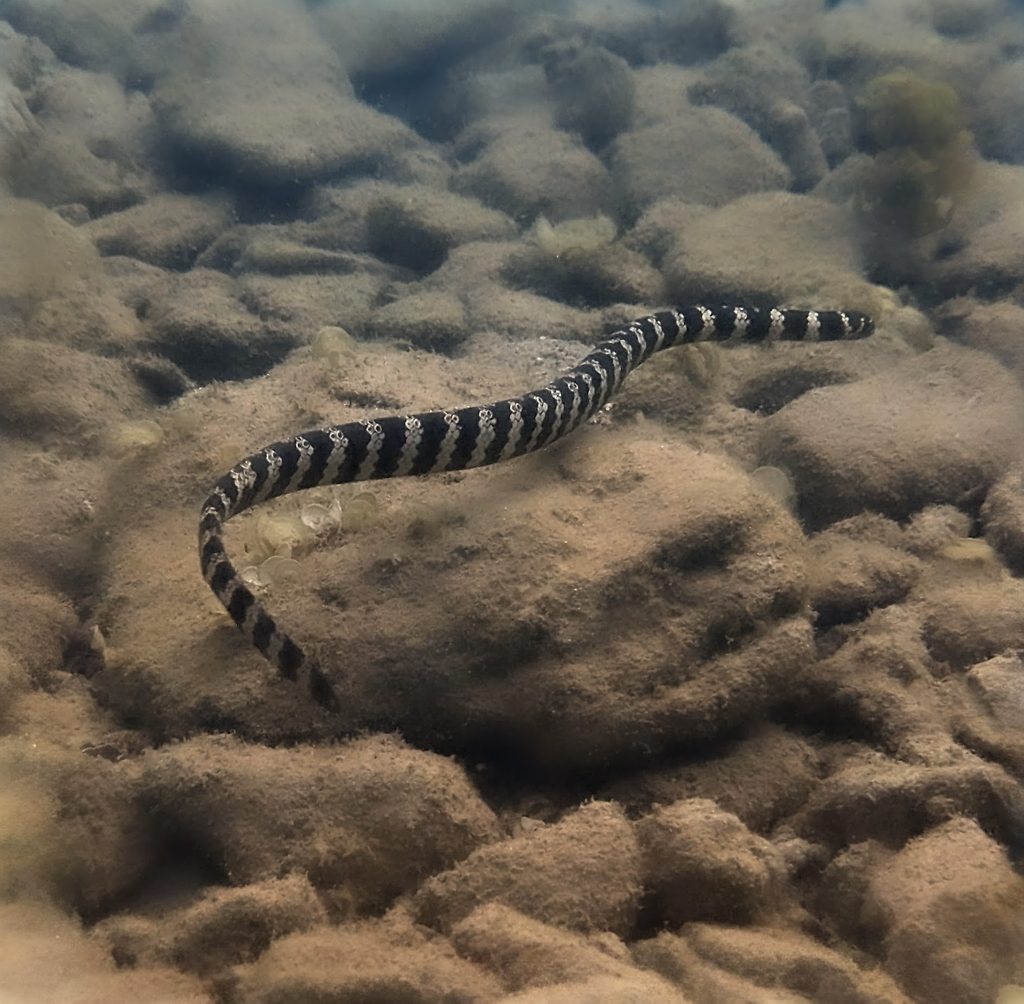
Photo: no rights reserved · CC0 · iNaturalist
Turtle-headed Sea Snake
Emydocephalus annulatus
Eats only fish eggs, and has given up the fangs to prove it. Still not a sea snake to handle.
- Length
- 75 cm – 1 m
- Active
- Diurnal
- Habitat
- Shallow coral reef and lagoons
- Diet
- Fish eggs, and nothing else
- Status
- Protected wildlife — licensed handlers only
Compare before you decide. Never act on an identification made from a photo or a guide, including this one.
Do not wash the bite, do not apply a tourniquet and do not try to catch the snake. Keep the person still, apply a pressure immobilisation bandage if you have one, and get emergency help immediately.
Native reptiles are protected wildlife. Taking, handling, moving or harming one without the appropriate permit is an offence under Queensland's Nature Conservation Act 1992 and carries significant penalties — as well as being the fastest way to get hurt.
The Turtle-headed Sea Snake is the odd one out among sea snakes. It eats nothing but fish eggs, and over evolutionary time it has largely given up the equipment that makes its relatives dangerous.
Its fangs are tiny, its venom glands are much reduced, and it is regarded as effectively harmless to people.
That is a fact about the species, not permission to handle sea snakes. The species that will hurt you and the species that will not are not reliably distinguishable in the water by anyone without training.
About the Turtle-headed Sea Snake
Adults reach around 75 centimetres to a metre, moderately built, with the usual laterally flattened body and paddle tail.
The pattern is bold and distinctive: broad, clean bands of black or dark brown alternating with cream, white or pale orange, running the whole length of the body.
The head gives the species its name — short, blunt and rounded, quite unlike the tapered head of other sea snakes. Males carry a small spine on the tip of the snout, used during courtship.
Habitat
Where can you find a Turtle-headed Sea Snake?
It is tied closely to coral reef, because its food is:
- coral reefs and reef flats
- shallow lagoons
- rubble and hard bottom adjoining reef
- areas with abundant damselfish and blenny nests
It occurs on Australian reefs including the Great Barrier Reef, and through the western Pacific. It is a shallow-water species and is rarely found far from live coral.
Venom
Is the Turtle-headed Sea Snake dangerous?
Not in practical terms. A diet of fish eggs requires no venom and no fangs worth speaking of, and this species has correspondingly reduced both — the fangs are minute and the venom apparatus is much diminished. It is regarded as effectively harmless to humans.
It should still never be handled, for two reasons. It is protected wildlife, and identifying sea snakes at close range is exactly the mistake that gets people bitten by the species that are dangerous.
If you cannot tell a Turtle-headed Sea Snake from a Dubois' Sea Snake underwater — and most people cannot — then the safe rule is the simple one: hands off, every time.
Diet
What does the Turtle-headed Sea Snake eat?
Fish eggs, and essentially nothing else:
- damselfish eggs
- blenny and goby eggs
- other demersal fish eggs laid on coral and rubble
It scrapes egg masses off coral and rock using its blunt snout and modified jaws. The whole animal — head shape, teeth, venom, behaviour — has been reshaped around that one food source.
Behaviour
What should you know about this species?
Turtle-headed Sea Snakes are diurnal and forage over shallow reef, surfacing regularly to breathe.
They are placid and slow-moving compared with other sea snakes, which reflects a diet that does not run away.
Interestingly, populations on reefs affected by pollution and human activity often become much darker or entirely black — a pigment change linked to shedding accumulated trace metals through the skin.
What to do if you see a Turtle-headed Sea Snake
Watch it and leave it alone. It is one of the more rewarding animals to observe on a reef and it needs nothing from you.
Do not handle it, even knowing what it is. It is protected wildlife, and close-range sea snake identification is not a habit worth developing.
If you find one stranded, treat it as you would any sea snake: do not touch it, and call us with the location.
Contributed photographs, reused under Creative Commons licences. Colour and pattern vary a lot between individuals — compare several before settling on an ID.
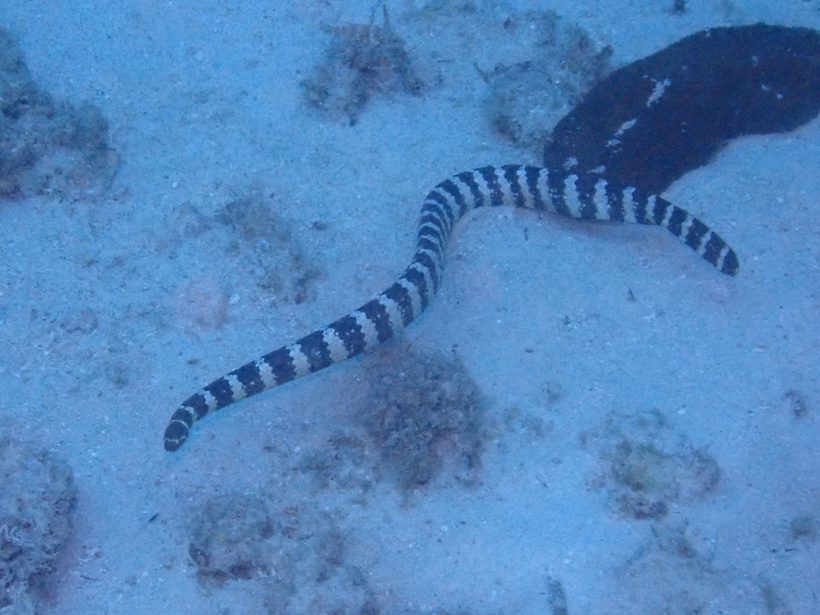
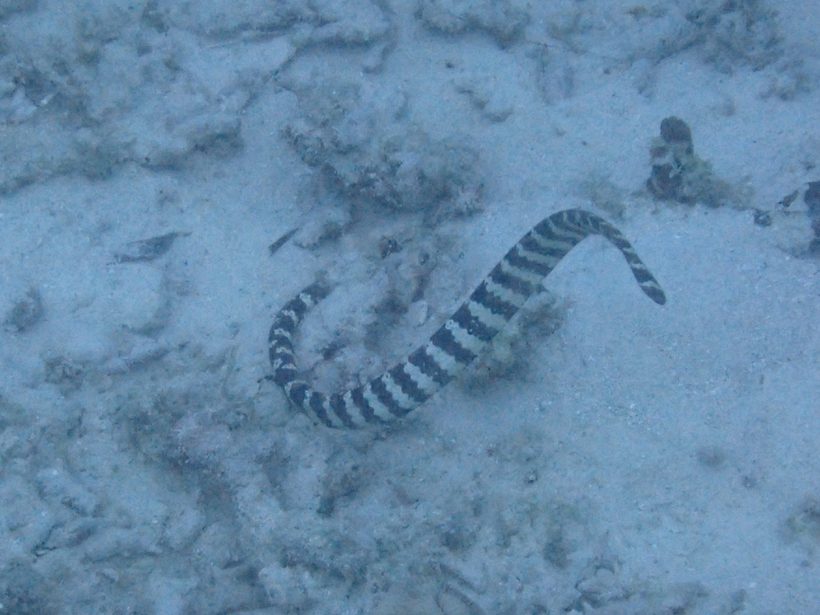
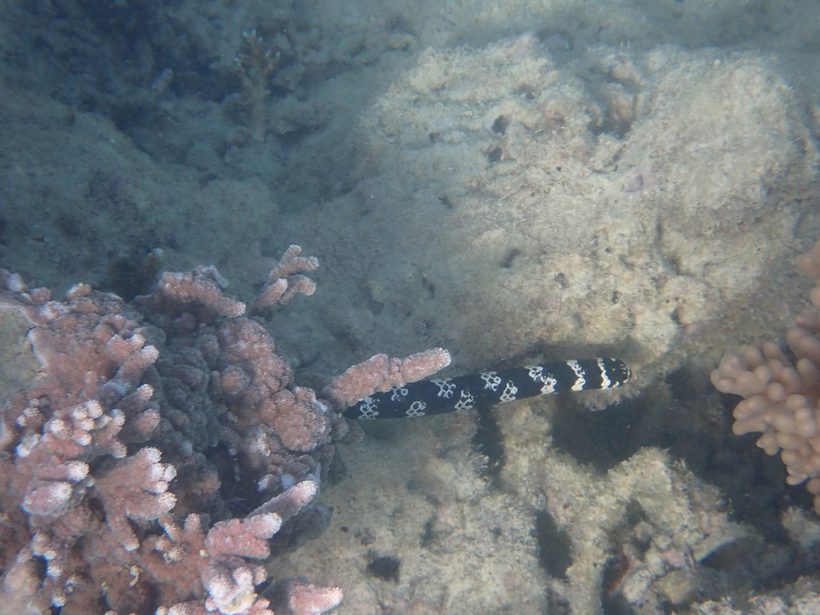
Photo: Ben Costamagna · CC BY 4.0 · iNaturalist
Photo: Ben Costamagna · CC BY 4.0 · iNaturalist
Photo: Debra Baker · CC BY 4.0 · iNaturalist
Asked on
most call-outs.
Is the Turtle-headed Sea Snake venomous?
So can I pick one up?
How do I identify one?
It really only eats fish eggs?
Why are some of them completely black?
Where would I see one?
Call or text — a licensed handler will talk you through it. If someone has been bitten, call 000 first.