
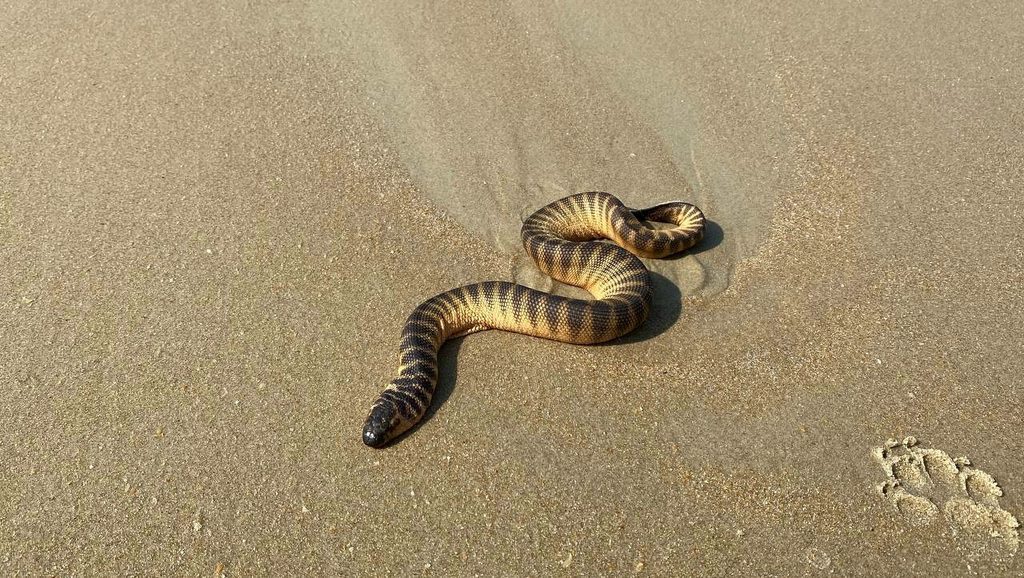
Photo: no rights reserved · CC0 · iNaturalist
Spine-bellied Sea Snake
Hydrophis curtus
Short, stout and the most common sea snake in trawl nets — which is exactly where the bites happen.
- Length
- to ~1 m
- Active
- Day and night
- Habitat
- Turbid inshore shallows, soft bottoms, trawl grounds
- Diet
- Bottom-dwelling fish, prawns
- Status
- Protected wildlife — licensed handlers only
Do not wash the bite, do not apply a tourniquet and do not try to catch the snake. Keep the person still, apply a pressure immobilisation bandage if you have one, and get emergency help immediately.
Native reptiles are protected wildlife. Taking, handling, moving or harming one without the appropriate permit is an offence under Queensland's Nature Conservation Act 1992 and carries significant penalties — as well as being the fastest way to get hurt.
The Spine-bellied Sea Snake is one of the most commonly encountered sea snakes in Queensland waters, and one of the most frequently washed up on South East Queensland beaches.
It is dangerously venomous, comes up regularly in trawl nets, and is short and stout enough that people underestimate it.
If you find one on the sand, treat it exactly as you would any other sea snake: leave it alone and call us.
About the Spine-bellied Sea Snake
This is a comparatively short, thickset sea snake, usually under a metre, with a noticeably large head for its size.
The body is grey-green to olive or pale brown, marked with broader darker bands that are strongest in young animals and often fade to near-uniform in large adults. The rear of the body is strongly flattened, ending in the usual paddle tail.
The name comes from the belly. Males develop spiny, sharply keeled scales along the underside, which are used during mating and are unlike anything on a land snake.
Habitat
Where can you find a Spine-bellied Sea Snake?
This species prefers soft bottoms and turbid inshore water rather than clear reef:
- shallow coastal waters and bays
- muddy and sandy bottoms
- estuary mouths and river plumes
- trawl grounds
- washed up on ocean beaches after storms
Its preference for exactly the water that prawn trawlers work in is why it is such a frequent bycatch, and why fishers see it more often than divers do.
Venom
Is the Spine-bellied Sea Snake dangerous?
Yes. It is dangerously venomous, with the neurotoxic and muscle-damaging venom typical of sea snakes. Any bite is a medical emergency.
This species accounts for a meaningful share of sea snake bites in Australia, and the reason is occupational rather than behavioural: it ends up in nets, and people take it out of nets by hand.
Apply a pressure immobilisation bandage, keep the person still and call 000. Sea snake antivenom exists and is effective.
Diet
What does the Spine-bellied Sea Snake eat?
It hunts over soft bottoms rather than in coral:
- bottom-dwelling fish
- catfish and eels
- prawns and other crustaceans
It forages along the seabed, which is precisely where a trawl net is working — the overlap is complete.
Behaviour
What should you know about this species?
Spine-bellied Sea Snakes are active by day and night and surface regularly to breathe.
They are not aggressive toward people in the water, and divers rarely encounter them because they favour murky inshore water. Almost every incident involves a snake already caught in gear or already stranded.
Strandings are common after storms and strong onshore winds, and an animal that has been rolled in surf is usually exhausted or injured by the time it reaches the sand.
What to do if you see a Spine-bellied Sea Snake
On a beach: keep back, keep dogs and children well away, and do not touch it — not with hands, not with a stick, and not with a towel. It is not dead, and it can still bite.
Do not try to return it to the water. A stranded sea snake is stranded because something is wrong, and putting it back does not fix that.
In a net or on a line: do not free it by hand. Note the location and call us — this is where the bites happen.
Contributed photographs, reused under Creative Commons licences. Colour and pattern vary a lot between individuals — compare several before settling on an ID.
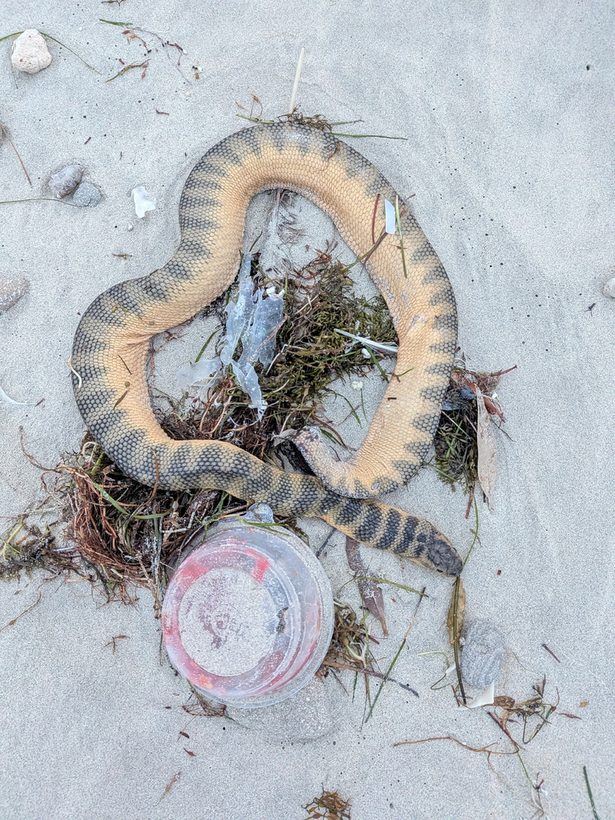
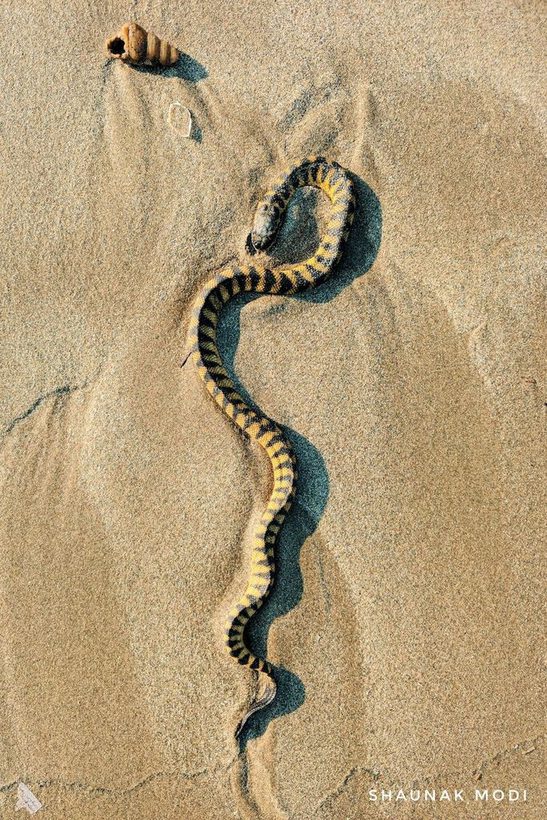
Photo: Theo Busschau · CC BY 4.0 · iNaturalist
Photo: Shaunak Modi · CC BY 4.0 · iNaturalist
Asked on
most call-outs.
Why do these end up on the beach so often?
It isn't moving — is it dead?
Why is it called spine-bellied?
How dangerous is a bite?
One is caught in my net. What do I do?
Can I put it back in the water?
Call or text — a licensed handler will talk you through it. If someone has been bitten, call 000 first.