
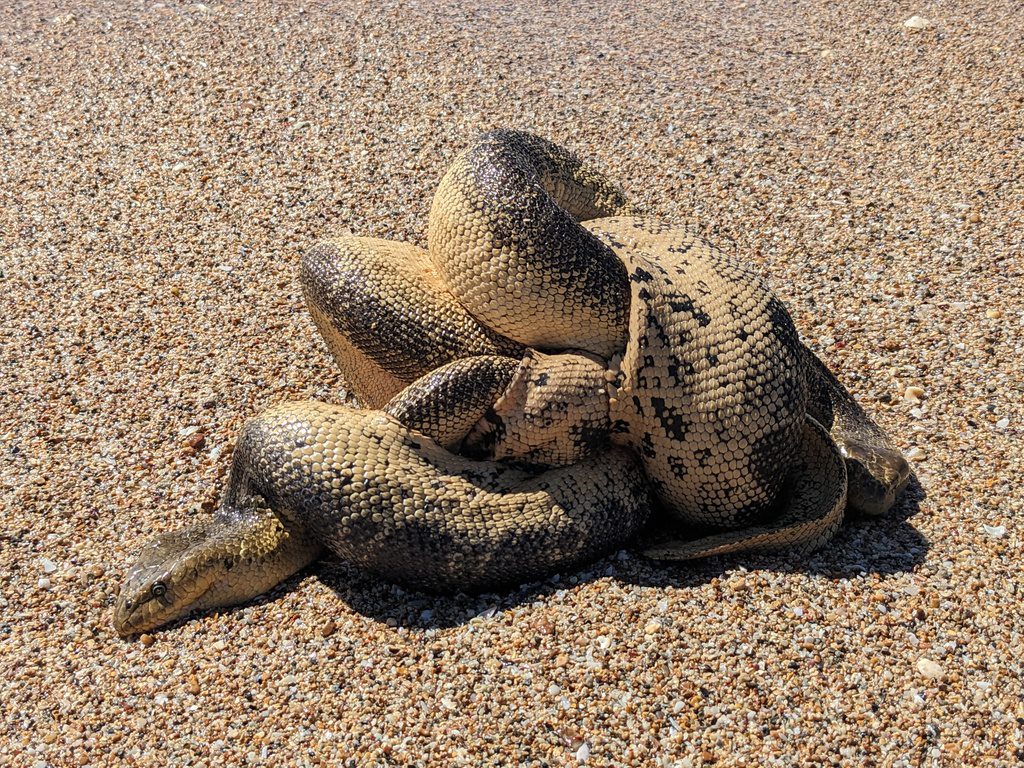
Photo: Hugo Innes · CC BY 4.0 · iNaturalist
Stokes' Sea Snake
Hydrophis stokesii
The heaviest sea snake in the world, with the longest fangs — long enough to get through a wetsuit.
- Length
- to ~1.6 m, very heavy
- Active
- Day and night
- Habitat
- Reef, sandy and muddy bottoms, coastal shallows
- Diet
- Bottom fish, eels
- Status
- Protected wildlife — licensed handlers only
Do not wash the bite, do not apply a tourniquet and do not try to catch the snake. Keep the person still, apply a pressure immobilisation bandage if you have one, and get emergency help immediately.
Native reptiles are protected wildlife. Taking, handling, moving or harming one without the appropriate permit is an offence under Queensland's Nature Conservation Act 1992 and carries significant penalties — as well as being the fastest way to get hurt.
Stokes' Sea Snake is the heaviest sea snake in the world — not the longest, but by a wide margin the bulkiest, with a body thickness that startles people who find one washed up.
It is dangerously venomous and has the longest fangs of any sea snake, long enough to penetrate a wetsuit.
It occurs along the Queensland coast and strands on east coast beaches, usually after heavy weather.
About Stokes' Sea Snake
Adults reach around 1.6 metres but are extraordinarily thickset for that length — a large one is roughly as heavy as a sea snake gets.
Colour varies from cream and pale brown to dark chocolate, usually with broad darker bands or saddles across the back that may join into a continuous dark stripe in some individuals. Many are strikingly pale beneath.
The most distinctive structural feature is a ridge of enlarged, keeled scales running along the centre of the belly, forming a definite keel. The head is large and heavy, matching the body.
Habitat
Where can you find Stokes' Sea Snake?
It occupies a range of coastal marine habitats:
- coral reef and rocky reef
- sandy and muddy bottoms
- coastal shallows and bays
- occasionally offshore in deeper water
- stranded on ocean beaches after storms
It has one behaviour worth knowing about: this species sometimes gathers in large surface aggregations, hundreds of animals drifting in slicks, which is a remarkable and very occasionally alarming thing to encounter from a boat.
Venom
Is Stokes' Sea Snake dangerous?
Yes, and it deserves particular respect. The venom is neurotoxic and myotoxic like other sea snakes, and this species has the longest fangs in the group — long enough to get through a wetsuit, which most sea snakes cannot manage.
It is also reported to be more inclined to defend itself than most sea snakes when handled or restrained.
Any bite is a medical emergency. Apply a pressure immobilisation bandage, keep the person still and call 000.
Diet
What does Stokes' Sea Snake eat?
A heavy-bodied ambusher of fish:
- bottom-dwelling fish
- eels
- reef fish
The heavy build and large head allow it to take comparatively large prey for a sea snake.
Behaviour
What should you know about this species?
Stokes' Sea Snakes surface to breathe like all sea snakes and spend most of their time on or near the bottom.
The surface aggregations are the exception — large numbers of animals concentrating in drift lines and slicks, apparently associated with breeding, and quite unlike anything else in Australian waters.
Stranded animals are heavy, obvious and often assumed dead. They are frequently neither dead nor safe.
What to do if you see Stokes' Sea Snake
Do not touch it, and do not let a dog near it. A thick-bodied sea snake on a beach attracts attention, and its size makes people bolder rather than more careful.
Do not try to return it to the water, and do not move it for a photograph.
Note where it is and call us. If someone is bitten, bandage, keep them still, and call 000 immediately.
Contributed photographs, reused under Creative Commons licences. Colour and pattern vary a lot between individuals — compare several before settling on an ID.
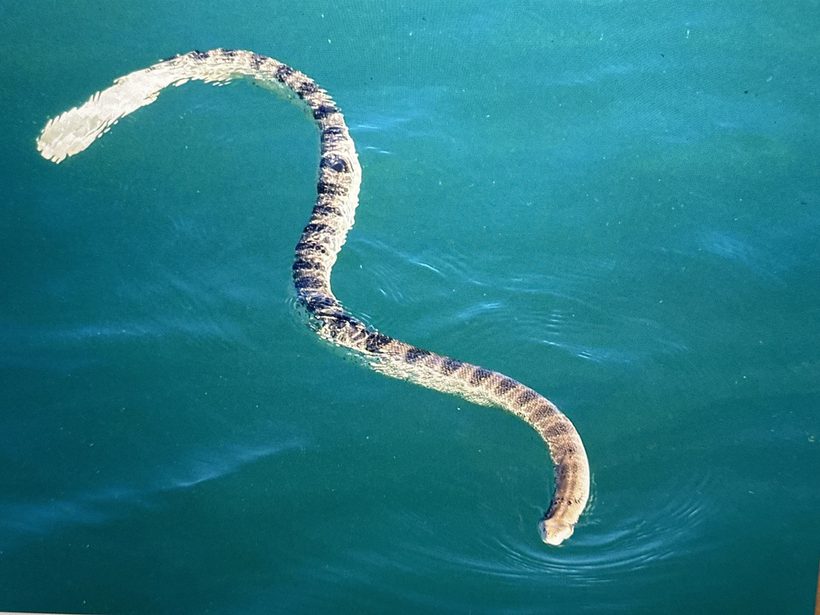
Photo: Rosario Douglas · CC BY 4.0 · iNaturalist
Asked on
most call-outs.
Is this really the world's heaviest sea snake?
Can it bite through a wetsuit?
How do I identify one?
I saw hundreds of sea snakes at the surface — was that this species?
Is it aggressive?
What do I do if I find one on the beach?
Call or text — a licensed handler will talk you through it. If someone has been bitten, call 000 first.