
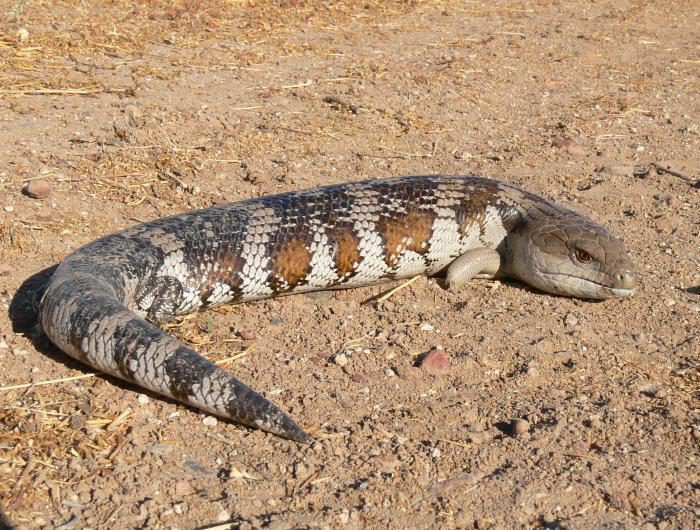
Photo: dhfischer · CC BY 4.0 · iNaturalist
Eastern Blue-tongued Lizard
Tiliqua scincoides
The lizard reported as a snake more than any other — and killed by snail bait more than anything else.
- Length
- to ~60 cm
- Active
- Diurnal
- Habitat
- Gardens, under decks, rockeries, woodpiles
- Diet
- Snails, slugs, insects, fruit
- Status
- Protected wildlife — licensed handlers only
Compare before you decide. Never act on an identification made from a photo or a guide, including this one.
Legless lizards are protected in Queensland exactly as snakes are. Taking, handling, moving, keeping or harming one without the appropriate permit is an offence under the Nature Conservation Act 1992, and penalties are substantial.
That applies whether or not you believed it was something else at the time. Killing a native reptile because you were unsure what it was is not a defence — and it is how a great many people are hurt by the ones that can hurt them.
If you cannot identify it, photograph it from a safe distance and send it to us. There is no penalty for asking.
The Eastern Blue-tongued Lizard is the reptile we are called about more than any other that is not a snake, and it is the one most often reported as one. Moving through grass with its short legs out of sight, a blue-tongue looks a great deal like a snake — and when cornered it hisses, flattens its body and opens its mouth, which does nothing to help.
It is a skink: the largest one most people will encounter, entirely harmless, and one of the most useful animals a garden can have.
Most of our blue-tongue call-outs are injuries. Dogs, cats, mowers, whipper-snippers and snail bait account for the overwhelming majority.
About the Eastern Blue-tongued Lizard
Adults reach around 60 centimetres, with a heavy sausage-shaped body, a broad triangular head and short, almost comically small legs.
The body is silvery-grey to fawn or brown, crossed by darker bands along the back and tail, and there is usually a dark stripe running from the eye back along the side of the head. The belly is pale.
The tongue is the giveaway and the reason for the name — a broad, bright blue tongue displayed with the mouth held open. That display is the animal's entire defence, and it is bluff from start to finish.
Description
How to tell it apart from a snake
In grass, with legs hidden, the confusion is understandable. Four things settle it:
- Legs. Short, but present. A snake has none.
- Ear openings behind the eye. Snakes have none.
- The tongue — broad, flat and bright blue, not thin and forked.
- The body shape — a thick, blunt, sausage-like body with a short tapering tail, quite unlike a snake's even taper.
If you are unsure, photograph it from a safe distance and send it to us. That is a far better outcome than acting on a guess.
Habitat
Where can you find an Eastern Blue-tongued Lizard?
Blue-tongues are thoroughly suburban and are found in gardens right across South East Queensland:
- gardens, lawns and mulched beds
- under decks, sheds and houses
- rockeries, retaining walls and woodpiles
- open woodland and grassland
- drains, pipes and dense ground cover
They shelter in one favoured spot and forage out from it, so a blue-tongue in your garden is usually a resident rather than a passer-by. Many live in the same yard for years.
Venom
Is the Eastern Blue-tongued Lizard dangerous?
No. Blue-tongues have no venom and pose no risk to people, children or pets.
A cornered blue-tongue will hiss loudly, flatten its body to look larger, open its mouth and show the blue tongue. It is entirely display. If actually grabbed it can deliver a firm bite with strong jaws — it has no teeth designed to cut, but it can pinch hard and hold on — which is a good reason to leave it be rather than a reason to fear it.
It is protected native wildlife, and taking, handling or moving one without a permit is an offence under Queensland's Nature Conservation Act 1992.
Diet
What does the Eastern Blue-tongued Lizard eat?
Blue-tongues are omnivores with slow, deliberate foraging habits:
- snails and slugs
- insects, beetles and caterpillars
- fallen fruit and berries
- flowers and soft plant matter
- carrion
Snails and slugs are a large part of the diet, which makes them genuinely valuable in a garden — and creates the single biggest threat to them.
Behaviour
What should you know about this species?
Blue-tongues are diurnal and spend a good deal of the morning basking, often on paths, driveways and warm concrete. That is exactly where mowers, cars and dogs find them.
They are slow. A blue-tongue cannot outrun anything, which is why its defence is bluff and why it comes off so badly against pets and machinery.
**Snail bait kills them.** A blue-tongue that eats poisoned snails is poisoned itself, and it is one of the most common causes of death we see in the species. If you have blue-tongues, do not use snail pellets — you have a better snail control system living in the garden already.
What to do if you see an Eastern Blue-tongued Lizard
Leave it alone. It lives there, it is harmless, and it is doing useful work.
Before mowing or using a whipper-snipper, walk the area first, particularly around long grass and edges. A large share of the injured blue-tongues we collect were hit by machinery.
If one has been caught by a cat or dog, call us even if it looks unharmed. Cat and dog bites introduce bacteria that kill reptiles days later, and a blue-tongue that seems fine on the day often is not. The same applies to any lizard that has lost its tail, is bleeding, or cannot move normally.
Contributed photographs, reused under Creative Commons licences. Colour and pattern vary a lot between individuals — compare several before settling on an ID.
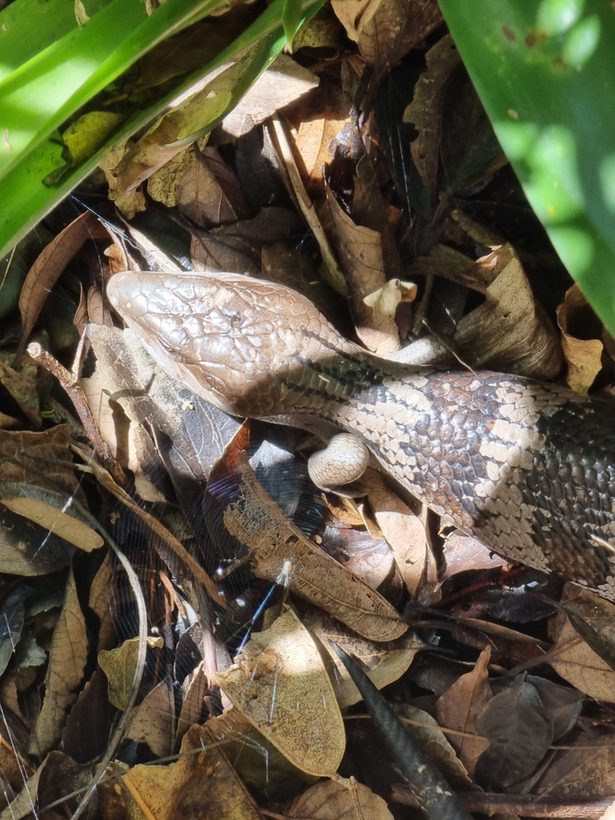
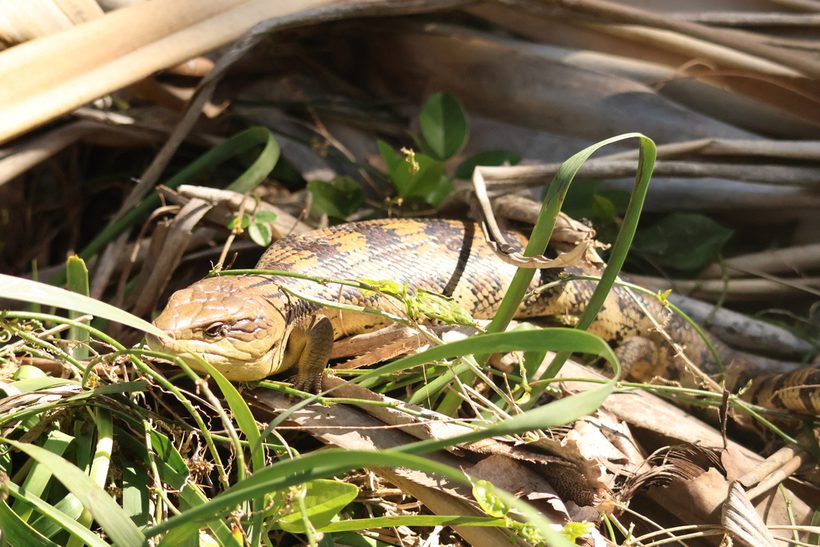
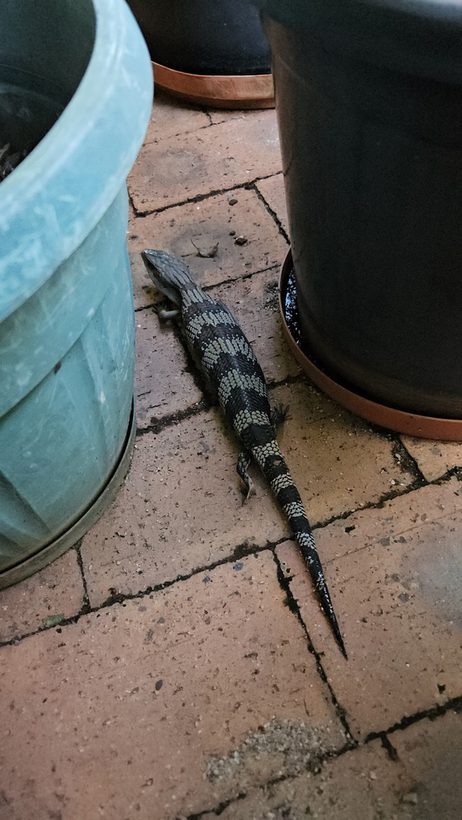
Photo: Martin Rady · CC BY 4.0 · iNaturalist
Photo: Patrick Connolly · CC BY 4.0 · iNaturalist
Photo: Sam Crabtree · CC BY 4.0 · iNaturalist
Asked on
most call-outs.
Is a blue-tongue a snake?
Are blue-tongues dangerous?
My dog caught one — it looks fine. Do I need to do anything?
Is snail bait really a problem?
Should I move it out of my yard?
How do I avoid hurting one when mowing?
Call or text — a licensed handler will talk you through it. If someone has been bitten, call 000 first.